


Page 53 - Demo
P. 53
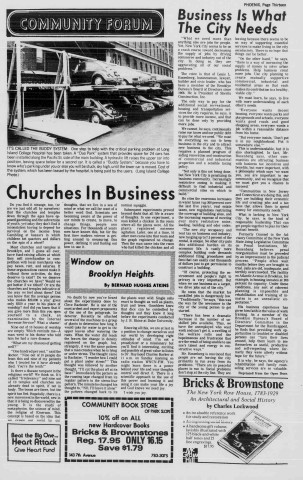
>1 jIT%u2019S CALLED THE BUDDY SYSTEM: One step to help with the critical parking problem at Long Island College Hospital has been taken. A %u201c Duo Park\been installed along the Pacific St. side of the main building. A hydraulic lift raises the upper car into position, leaving space below for a second car. It is called a \know who's parking under you or else you will be stuck, sky high, until the lower car is moved. Cost of the system, which has been leased by the hospital, is being paid by the users. (Long Island College Photo)Churches In BusinessDo you find it strange, too, (orare we just odd all by ourselves)that the churches and templesdown through the ages have opposed gambling and the subversionof youth, yet today they don%u2019t find itinconsistent having to depend' forsurvival on the income fromGambling at bazaars in whichchildren bet quarters and dollarson the spin of a wheel?Most churches and temples inBrooklyn, and I guess all over,have fund-raising affairs at whichthey sell merchandise in competition with local merchants whopay taxes, rent, and salaries. Ifthese organizations cannot make itwithout these activities, do theydeserve to exist? Do we deservethe churches we have? Would weget better if we tithed? Or are thechurches and temples indicative ofthe way we feel about them? Didyou know that the average personwho makes $20,000 a year givesonly $350 a year to his place ofworship? And did you know that ifyou give more than this you openyourself to a check, anexam ination by the InternalRevenue Service? What a shame!Nine out of 10 houses of worshipare empty. Which reminds me%u2014Aman went to his doctor who toldhim he had a rare disease.%u201cWhat are my chances of gettingwell?%u201d%u201cOne hundred percent,%u201d said thedoctor. %u201cNine out of 10 people diefrom this and nine of my patientswho I treated for it have alreadydied. You%u2019re the tenth!%u201dIs there a disease rampant in thereligious world? We think so. It%u2019scalled %u201cIrrelevancy%u201d and nine, outof 10 temples and churches arealready dead in spirit, if not inbody. The bones are there, but thespirit has fled. Hopefully, there is anew movement in the world, new inthat it is being re-discovered by theyoung. It is the study ofmetaphysics, the science of mind,the religion of Emerson. Thisconcept is based on the idea that----------- -----------------4 - ------------- --------------- 1 1 | ____ ______w c t t c a t c uui wunu uy uuithoughts, that we live in a sea ofmind or what we call for want of abetter word God. Scientists arebecoming aware of the power ofour minds to create, to move, tochange things, people anasituations. For thousands of yearsmen have known this, but for thefirst time modern science is getting around to measuring thispower, defining it and finding outhow to use it.normal squiggle.Subsequent experiments provedbeyond doubt that all life is awareof thoughts. In one experiment, aman kolled a chicken in the roomwhere all the plants were. All theplants registered extremeagitation. Later, one at a time, 10other men came into that room andthe graph registered no change.Then the man came into the roomwho had killed the chicken and allm Window onBrooklyn HeBy BE R N AR D HU G H ES A T K IN SNo doubt by now you%u2019ve heardabout the experiments done byCleve Backster. He is one of themost ardent and expert proponentsof the use of the polygraph, liedetector. Recently he attachedseveral of the machines to a groupof plants to determine how long itwould take for water to get to theupper leaves after watering theroots. When the water did reachthe leaves the change in densityregistered on the graph, but,strangely, it was the same patternthat a man creates when he is lyingor under stress. The thought cameto Backster, %u201cI wonder how I couldput a plant under stress?%u201d Thisthought was followed by anotherthought, %u201cI%u2019ll cut the plant off at itsbase!%u201d Immediately the pattern onthe running tape changed from itsregular pattern to the stress-fearpattern. The minute he changed histhought to, %u201cNO, I%u2019ll leave it alone%u201dthe pattern changed back to itsthe plants went wild. Single cellsreact to thought as well as plants,fruit and trees. Gamblers knowthat dice can be controlled bythoughts and they knew it longbefore the experiments conductedby J. B. Rhine at Duke University.Knowing all this, we are at last ina position to change ourselves andour world by developing rightattitudes of mind. I%u2019m not aproselytizer or a missionary butyou%u2019ll find it interesting, excitingand possibly of great value to listento Dr. Raymond Charles Barker at11 a.m. on Sunday morning onradio station WNCN-FM. Youmight learn there is a powerbehind your life and your thoughtscontrol and direct it. There is ascientific approach to the use ofthis power and learning it andusing it can make your life a joyand God knows we need joy.I wish you joy.55Beat the Big One...Heart AttackGive Heart FundCOMMUNITY BOOK STOREO f PARK SLOPE!1G% off on ALL new Hardcover BooksBricks & Brow nstones R eg. 17.95 ONLY 16.15Save $1.79783-3075 1BusinessThe City%u201cWhat we need more thananything else are jobs for people.Yet, New York City seems to be ona crash course toward decreasingthe supply of jobs by drivingcommerce and industry out of thecity. In doing so, they areaggravating all of our socialproblems.%u201dThe voice is that of Louis L.Rosenberg, businessman, lawyer,builder and civic leader, who hasbeen a member of the BrooklynBureau%u2019s Board of Directors since1968. He is President of SheriluConstruction, Inc.The only way to pay for theadditional social recreational,housing and transportation services the city requires, he says, isto provide more income, and thatcan be done only by providingmore jobs.We cannot, he says, continuouslyraise our taxes and our public debtto pay for what we need. %u201cWe mustdo everything we can to keepbusiness in the city and to attractnew business to the city. Thisrequires a planned program ofaiding renovation and constructionof com m ercial and industrialproperties and a sensible taxingpolicy.%u201cNot only is this not being done,but New York City is penalizing itsbusiness community. Increasinglyrestrictive zoning is making itdifficult to find industrial andcommercial sites on which tobuild.%u201dHe cites the enormous increasesin water taxes (up 300 percent overthe last five years), real estatetaxes, new regulations restrictingthe coverage of building sites, andthe increasing expense of meetingever more restrictive noise,loading, building and odor codes.%u201cThe new city occupancy andrent tax on business and industry,now ranging up to 7.5 percent of therental, is unique. No other city putsthis additional burden on itseconomic life. A vastly morecomplex building code demandsadditional filing procedures andfees that can easily cost thousandsof dollars just to get permission toconstruct a building.%u201cOf course, protecting the environment and people%u2019s right toprivacy is very important. Butwhen we use business as a target,we drive jobs out of the city.%u201dHe notes that the market forunskilled jobs is dangerously low.%u201cTraditionally,%u201d he says, %u201cthis wasthe way for the newcomer to thecity or the young person to getstarted.%u201cThere has been a dramaticdecrease in the number of unskilled jobs available. Thus, wehave the unemployed who wantwork and can%u2019t get it, a swelling ofthe welfare rolls and thehopelessness and frustration thatare the result of being unable to useone%u2019s talent and energy in constructive ways.%u201dMr. Rosenberg is convinced thatpeople are not leaving the cityprimarily to run away from itsproblems. %u201cThere are no peacefulplaces to run to. Social problemsdon%u2019t stop at the city line. They arePHOENIX, Page ThirteenIs WhatNeedsleaving because there seems to beno way of supporting essentialservices to make living in the citysatisfactory. There is no hope thatthings can be better.%u201cOn the other hand,%u201d he says,%u201cthere is a way of increasing thesupply of money to solve urbanproblems. Help business creatmore jobs. Use city planning tocreate mutually supportivecom m ercial, industrial andresidential areas so that eachmakes its contribution to a healthy,viable city.%u201dWe must learn, he says, to livewith more understanding of eachother%u2019s needs.%u201cEveryone wants decenthousing, everyone wants parks andplaygrounds and schools, everyonewants good roads and goodshopping areas, everyone wants ajob within a reasonable distancefrom his home.%u201cBut everyone insists, %u2018Don%u2019t putit in my neighborhood. Put itsomewhere else.%u2019%u201dThis is understandable, but it isalso shortsighted. In fact, Mr.Rosenberg says, other com %u00admunities are attracting businesswith business tax incentives andbenefits, but more important, witha philosophy which says %u2018we wantyou, you are important to ourcommunity, and we recognize thatwe must give you a chance tosucceed.%u2019%u201cCommunities in New Jerseyand Connecticut are doing this, andthey are building their economiclife and creating jobs and a taxbase that allows them to spendmoney for community needs.%u201dWhat is lacking in New YorkCity, he says, is the kind ofresponsible leadership That canget people together to plan for theirmutual benefit.Formerly Counsel to the Advisory Committee of the New YorkState Joing Legislative Committeeon Penal Institutions, Mr.Rosenberg believes penalreorganization must be precededby an improvement in the judicialprocess. %u201c People often waitmonths before they are brought totrial. Jails are old, inadequate, andterribly overcrowded. The facilityon Atlantic Avenue in Brooklyn, forexample, is housing inmates at 200percent its capacity. Under theseconditions, any sort of coherentplanning is im possible andrehabilitation and training of inmates is an unrealistic expectation.%u201dHis business experience hasgiven him faith in the value of worktraining. As a member of theBrooklyn Bureau%u2019s Board ofDirectors%u2019 Committee in theDepartment for the Handicapped,he finds that providing work opportunities to troubled or disabledpersons can %u201cturn their livesaround, help them learn to seethemselves as useful, productiveand self-respecting where formerly they were utterly withouthope for the future.%u201dIt is why, he says, the agency%u2019srehabilitation and family counseling services are so valuable.Reprinted from the Open Door.Bricks &BrownstoneThe New York Row House, 1783-1929An Architectural and Social Historyby Charles Lockwood* An invaluable reference workfor study and restoration* %u2014 %u2022 %u2022 i i %u2022 . %u2022 cngi uaaing aucicii maiuiy# A handsome gift volume,lavishly illustrated with175 black-and-whitehalf tones and 25line engravings, k n117.95143 7 * Avenue Liill!!


