


Page 8 - Demo
P. 8
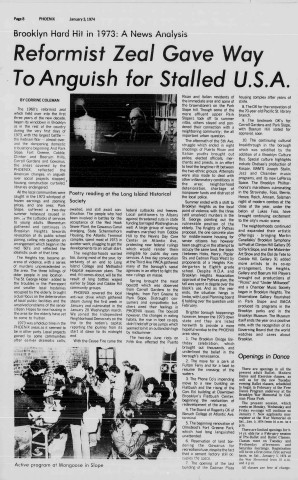
Page 8 PHOENIX January 3,1974Brooklyn Hard Hit in 1973: A News AnalysisReformist Zeal Gave WayTo Anguish for Stalled U.S.A.5. The beginning renovation of Oimstead's Fort Greene Park, which had long languished unattended.6. Reservation of land bordering the Gowanus for recreational use, despite the fact that a cement factory still ocf ' > IU a a r> a a auupico ii ic ofjacc.Rican and Italian residents of the immediate area and some of the brownstoners on the Park Slope hill. Though some of the more affluent upper Park Slopers took off to summer villas, others stayed and pondered their connection with a neighboring community; the all important urban question.The aftermath of the 5th Ave. struggle which ended in eight shootings of Puerto Rican and Italian youths brought out police, elected officials, merchants and priests, in an effort to heal the longtime rift between the two ethnic groups. Attempts were also made to deal with other inflammatory conditions in the area; neighborhood deterioration, shortage of manpower funds and distrust of the local police.Summer ended with a shift to Brooklyn Heights as the focal point of violence, with the three (still unsolved) murders in the St. George, pointing out the vulnerable position of the elderly. The Knights of Pythias proposal, the one concrete plan for middle-income housing for senior citizens has however been caught up in the attempt to occupy the same land, the block (between Hicks, Henry, Poplar Sts. and Cadman Plaza West) by proponents of a Heights Kindergarten to Eighth grade school. Despite H.D.A. and Brooklyn Heights Association approval of the Pythias plan, the fall was spent in degate over the block%u2019s use. And as the year ends, the situation hangs in limbo, with Local Planning board 6 holding over the question until February.BY CORRINE COLEMANThe 1960%u2019s reformist zeal which held over into the first three years of the new decade, began its winddown in Brooklyn as in the rest of the country during the very first days of 1973, with the largest battle %u2014 the Vietnam War %u2014 almost over, and the dampening domestic tribulations beginning. And Park Slope, Fort Greene, Cobble, Clinton and Boerum Hills, Carroll Gardens and Gowanus, the areas covered by the PHOENIX, reflected the American changes, in anguish over social projects stopped, < housing construction curtailed,%u2019 libraries endangered.All the local communities were caught in the 1973 whirlpool of frozen earnings and zooming prices, and one area; Park Slope, suffered a two-day summer holocaust caused in pan by the cutbacks of services to young adults. Momentum gathered and continues in Brooklyn Heights towards revocation of its public school pairing, calling into question an arrangement which began in the mid '60's and reflected the idealistic push of that time.The Heights too, became an arena of violence, with a series of murders unprecedented in the area. The three killings of older people in one location - The St. George Hotel - added to the troubles in the Pierrepont and smaller local hostelries occupied by the elderly, brought a dual focus on the deterioration of local public facilities and the unsolved problems of the senior citizen. Hopes for new housing in the area for the elderly have yet to come to fruition.1973 was a holdup time in the PHOENIX areas as it seemed to be in other parts. Local projects gained by some communities after earlier dramatic calls,Poetry reading at the Long Island Historical Societyawaited, and still await construction. The people who had been involved in battles for the acceptance of the Red Hook Sewer Plant, the Gowanus Canal dredging, State Schermerhorn Housing, the Atlantic Terminal complex, spent most of-1973 in quieter work, plugging to get the developments to an actual start.The neighborhoods waited too, during most of the year, for certainty of an end to Long Islznd College and Methodist* Hospital expansion plans. The end, if it comes about, will be the result of long battles waged earlier by Slope and Cobble Hill community groups.PHOENIX covered the local anti-war drive which gathered steam during the first week in January and culminated in the January 20 Washington march. We joined the Independent Neighborhood Democrats on the trip to the nation's capital, reporting the journey from its start at dawn to its midnight end.With the Cease Fire came thefederal cutbacks and freezes. Local petitioners to Albany against threatened cuts in state funding barraged Washington as well. A large group of working mothers marched from Cobble Hill to the Nevins Day Care Center on Atlantic Ave., protesting new federal rulings which would render them ineligible for public day care services. A two day convocation at the Third Ave YWCA gathered many of the borough%u2019s social agencies in an effort to fight the new rulings en masse.Spring brought the meat boycott which was observed from Carroll Gardens to the Heights; from Fort Greene to Park Slope. Distraught consumers and sympathetic butchers aired their feelings in PHOENIX issues. The boycott however, the changes in eating habits, the rise in food co-ops, didn%u2019t hold off price jumps which seemed to hit an outlandish high by midsummer.The two-day June riots on Fifth Ave. affected the PuertoBrighter borough happenings however, temper the 1973 down state and they are listed herewith to provide a more hopeful windup to the PHOENIX area story.1. The Brooklyn Bridge Birthday celebration, which brought out thousands, and underlined the belief in the borough%u2019s renaissance.2. The move for a park at Fulton Ferry and for a boat to resume the crossing of the waters.3. The Phone Co's impending move to a new building on Flatbush and the rising of the Con. Ed. building at Downtown Brooklyn%u2019s Flatbush Center, beginning the realization of redevelopment of the area.4. The Board of Regents OK of Baruch College at Atlantic Ave.W.%u00ab T #Active program at Mongoose in Slope 7. The opening of the last building of the Cadman Plazahousing complex after years of strife.8. The OK for the renovation of the 70-year-old Pacific St. library branch.9. The landmark OK%u2019s for Carroll Gardens and Park Slope, with Boerum Hill slated for approval, soon.10. The continuing cultural breakthrough in the borough which was solidified by the addition of a Brooklyn Culture Bus. Special culture highlights include Chelsea's production of Kaspar, BAM%u2019S Joseph Stalin, Jazz and Chamber music programs, and its new LePercq Space. The Brooklyn Philharmonia%u2019s marathons culminating in the Stravinsky, Foss, Berrio, Henze, Reich, Amram, Salzman night of modern combos at the close of the year, under the baton of Lukas Foss, have brought continuing excitement to the city%u2019s music scene.The neighborhoods continued and expanded their artistic offerings - bringing Martin Canellakis' Brooklyn Symphony to Pratt at Clinton Hill Gallery 26 to Park Slope, and the Midwinter Art Show and the Bal de Tete to Cobble Hill. Gallery 91 added more artists to its co-op arrangement, the Heights, Gallery and Boerum Hill Players brought out productions of \and a Chamber Music Society began in Brooklyn Heights. The Brownstone Gallery flourished in Park Slope and BACA produced its programs in the Brooklyn parks and in the Brooklyn Museum. The Museum itself ends the year on a positive note, with the recognition of its Governing Board that the world watches and cares about Brooklyn.Openings in DanceThere are openings in all the present adult Ballet, Modern Dance and Exercise classes, as well as for the new Tuesday evening Ballet classes, scheduled to begin in February at the Free Dance Program underway at the Brooklyn War Memorial in Cadman Plaza Park.The present session, which meets on Monday, Wednesday and Friday evenings will continue on January 7. New applicants may register at the War Memorial on Sat., Jan. 5, 1974 from 10 a.m. to 4p.m.There are limited openings for 9- 14 yr. olds for a February session of Pre-Ballet and Ballet Classes. Classes meet on Tuesday and Wednesday afternoons and Saturday mornings. Registration will be on a first come, first served basis, on Sat., January 5, 1974 at iiie War Memorial from iO a.m.and 4 p.m.All classes are free of charge.


