


Page 304 - Demo
P. 304
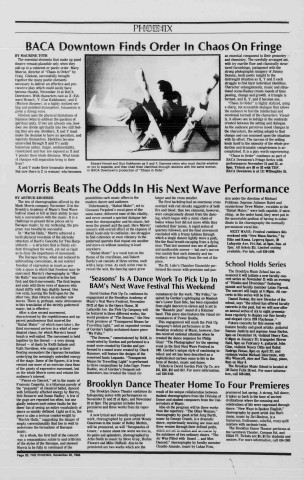
PHSECTION 2 IXBACA Downtown Finds Order In Chaos On Frinee< L /BY MAURINE TOTHThe essential elements that make up good theatre remain plausible only when they add up in a coherent or poetic order. Mary Monroe, director of %u201cChaos in Order%u201d by Craig Gholson, successfully brought together the many poetic elements necessary to deliver an effective and provocative play which could easily have become chaotic, November 14 at BACA Downtown. With characters cast as X (Edward Henzel), Y (Gus Kaikkonen), and Z (Michele Steame), in a highly stylized setting and polished atmosphere, humanism is given a strong voice.Gholson uses the physical limitations of Siamese twins to address the question of spiritual unity. If two are already one, how does one divide spiritually into two still feeling they are one. Brothers, X and Y must make the decision to have an operation, and separate themselves. Identities become unravelled through X and Y%u2019s sadly humorous antics. Anger, sentimentality, resentment and fear are exposed as X and Y ponder their bleak dilemma. What kinds of changes will separation bring to their lives? Edward Henzel and Gus Kaikkonen as X and Y, Siamese twins who must decide whetherX and Y make their traumatic decision. or not t0 separate, and then chart th eir identities through relations with the same woman,But now there is Z (a woman) who becomes in %u00aeAC^A Downtown s production of Chaos in Order.an essential component to their geometry %u2014 and chemistry. The carefully arranged set, with icy marble floor and classically structured furnishings, juxtaposed with the strong photographic imagery of Jimmy Desana, lends poetic insight to the distraught situation as X, Y and Z each struggle to find their individual identities. Character entanglements, music and situational scene-flashes create moods of time passing, change and growth. A triangle is formed, and X, Y, and Z become one.%u201cChaos In Order%u201d is highly stylized, using a sharp, but accessible dialogue that allows the audience to feel the intellectual and emotional turmoil of the characters. Visually, it allows one to indulge in the contrasts created between the setting and dialogue.As the audience perceives mood changes in the characters, the setting adapts to that change and can comment upon the situation with its effect. The success of the setting lends itself to the intensity of the whole production and dramatic completeness is accomplished. It is a play worth experiencing.%u201cChaos in Order%u201d continues as part of BACA Downtown%u2019s Fringe Series with performances November 21 and 22, at 8pm. Tickets are $8 or $3 with TDF.BACA Downtown is at 111 Willoughby St.Morris Beats The Odds In His Next WaveBY ARTHUR KROEBERThe trio of choreographies offered by the Mark Morris company November 12 in the Brooklyn Academy of Music%u2019s Next Wave festival stood or fell on their ability to sustain a conversation with the music. It is a challenge to present three pieces set to Baroque music; by my reckoning, the program was two-thirds successful.In %u201c Marble Halls,%u201d Morris achieved a lucid phyiscal evocation of the intricate structure of Bach%u2019s Concerto for Two Harpsichords %u2014 a structure that is firmly evident throughout the work, yet not so rigid as to deny the importance of movement.The Baroque forms, when not reduced to unbreathing conventions, do not restrict freedom of expression so much as provide a space in which that freedom may be exercised. Morris%u2019s choreography in %u201cMarble Halls%u201d was most effective in the fast first and third movements. The first begins and ends with three rows of dancers who stand stiffly with legs slightly bowed. One row exits, leaving the field open for the other two, then returns as another row leaves. There is, perhaps, some obviousness in this translation of the strictly patterned music, but is effective.After a slow second movement, characterized by the repetitiveness and apparent pointlessness that marred the %u201cStabat Mater%u201d (of which more later), the third movement arrives in a whirl of coordinated chaos, for which Morris%u2019s broad brush is well-suited. The movement is held together by the thread %u2014 a very strong thread %u2014 of duets by Keith Sabado and Ruth Davidson, who suggest in their fleeting encounters the rigorous formalism underlying the seemingly unbridled energy of the stage. Some of the figures, it is true, remind one more of an exercise class than of the gaiety of expressive movement, but on the whole Morris earns and retains the audience%u2019s interest.%u201c Pieces en Concert,%u201d set to the music of Francois Couperin, is a hilarious parody of the %u201cpeasants%u201d of classical ballet, danced with brilliantly affected energy by Morris, Rob Besserer and Susan Hadley. A few of the gags are repeated too often, but one gladly endures such minor faults for the sheer fun of seeing an entire vocabularly of dance so nimbly deflated. Light as it is, the piece is also a serious counterweight to %u201cMarble Halls,%u201d suggesting the danger of empty conventionality that lies in wait to undermine the formalism of Baroque music.As a whole, the first half of the concert was.a conscientious salute to and criticism of the styles of the Baroque, and showed Morris to be fully in command of thepossibilities such music offers to the modern dancer and audience.Unfortunately, %u201cStabat Mater%u201d, set to Giovanni Pergolesi%u2019s vocal piece of the same name, delivered none of this vitality, and never seemed a spirited dialogue between the choregorapher and his music, between the present and the past. Here Morris%u2019 concern with overall effect at the expense of detail leads only to confusion; one struggles to find coherence or even vibrancy in the patterned quartets that repeat one another and move on without seeming to lead anywhere.%u201cStabat Mater%u201d is a vocal text on the theme of the crucifixion, and Robert Bordo%u2019s set consists of three scrims, each with a large cross. As each scrim rose to reveal the next, the dancing space grewDavid Gordon Pick Up Co. continues its engagement at the Brooklyn Academy of Music%u2019s Next Wave Festival, November 20-22 at 8pm in the Opera House, 30 Lafayette Ave. the Pick Up Company will be featured in three different works; the world premiere of %u201cThe Seasons,%u201d the New York premiere of %u201cTransparent Means for Travelling Light,%u201d and an expanded version of Gordon%u2019s highly acclaimed dance piece %u201cMy Folks.%u201d%u201cThe Seasons,%u201d commissioned by BAM, is constructed by Gordon and performed to a sound score created by Gordon and performed to a sound score created by Chuck Hammer, will feature the designs of the renowned Santo Loquasto. %u201cTransparent Means for Travelling Light%u201d is performed to three compositions by John Cage. Power Boothe, one of Gordon%u2019s frequent collaborators, has created the visual cirBrooklyn DanceThe Brooklyn Dance Theater continues its fall-opening series with performances on November 21 and 22 at 8pm; and November 23 at 2pm. The program includes four premieres and three works from its repertory.A new lyrical and visually sculptured work, choreographed by guest artist Wendy Osserman to the music of Robby Merkin, will be premiered, as will %u201cReceptacles of Grace,\its pains and splendors, choreographed by Artis Smith to music by Steve Gray, Herbie Flowers and Mike Oldfield. Also to be premiered are two works which are thelarger and the cross smaller.The first backdrop had an enormous cross overlaid with red streaks suggestive of both fire and blood; thse two elements, however, were conspicuously absent from the dancing, which began with a static chain of bodies whose feet did not move while they contorted their torsos. A rapid series of quartets followed, and the final movement concluded with a frozen tableau through which a single dancer lightly wove a path, like the final breath escaping from a dying man. That last moment was one of pathos and unutterable sorrow %u2014 but one%u2019s sorrow was mainly that such intensity and immediacy were lacking from the rest of the piece.The St. Luke%u2019s Chamber Ensemble performed the music with precision and pascumstances for the work. %u201cMy Folks,%u201d inspired by Gordon%u2019s upbringing on Manhattan%u2019s Lower East Side, has been expanded from eight dancers to eleven and is set to the %u201cHassidic jazz%u201d sound of a Klezmer band. This piece also features the visual circumstances of Power Boothe.This engagement will mark the Pick Up Company%u2019s debut performance at the Brooklyn Academy of Music, however, Gordon received national attention when he created the dance sequence for Philip Glass%u2019 %u201cThe Photographer%u2019 for the opening event in the first Next Wave Festival in 1983. Gordon%u2019s unique style of combining intellect and wit has been described as a sophisticated cartoon come to life in the form of theater, music and dance.Tickets to David Gordon Pick Up Co. are $25, $20, $16 and $12. For more information, call 636-4100.result of the unique collaboration between student choreographers from the Division of Dance and student composers from the Conservatory of Music.Also on the program will be three works from the repertory. %u201cThe Other Woman,%u201d choreography by guest artist Jurg Burth, music by George Crumb, is a dramatic dance, mysteriously weaving one man and three women through their defined paths,w i l R .l l a i c a c i u i u i v u u i i a i u i tm c u t u s c \\jythe existence of two ordinary chairs. %u201cThe Air Was Filled with Sound ... and Men Danced,%u201d choreography by faculty member Claudio Assante, music by Lukas Foss,Performancesion under the direction of Michael Feldman. Soprano Julianne Baird and countertenor Drew Minter, vocalists in the %u201cStabat Mater,%u201d were both capable, if unexciting; on the under hand, they were put in the unenviable position of having to subordinate to the choreography the normally pre-eminent vocal line.NEXT WAVE: Festival continues this weekend with %u201cNew Moon Stories,%u201d by Eiko and Koma. Lepercq Space, 30 Lafayette Ave. Fri.-Sat. at 8pm, Sun. at 2pm. All tickets $15. Limited seating available. For info, call 636-4100.School Holds SeriesThe Brooklyn Music School has announced it will initiate a new faculty concert series on November 21 with an evening of %u201cEtudes and Diversions%u201d featuring pianist and faculty member Lalan Parrott. The concert will begin at 6:30pm. All concerts in this series will be free.Daniel Rostan, the new Director of the school, says %u201cthe school has offered faculty concerts in the past, but we will now offer an annual series of six to eight presentations regularly to display our fine faculty and elegant circa 1919 PlayhouseFuture concerts for this season will feature faculty and guest artists: guitarist Ramon Justicia and soprano Anna Bartos, 3pm on December 14; violinist Henry Kao, 6:30pm on January 23; trumpeter Steven Reid, 8pm on February 4; guitarist John Glen, violinist Nancy Ditto and flutist Rodrigo Henao, 8pm on April 22; and violinist/violist Michael Interrante, with Mia Winecoff, oboe and Tian Jiang, piano, 8pm on May 8.Hie Brooklyn Music School is located at 126 Saint Felix Street. For more information, call 638-5660.premiered last spring. A strong, full dance, it takes us back to the time of ancient civilizations where the meaning and celebrations of life were expressed through dance. %u201cNew Ways to Spoken English,%u201d choreography by guest artist Jan Hartmann, music by Jiri Stedron, is a humorous, frolicsome, colorful, crazy-quilt mixture with sardonic twist.The Brooklyn Dance Theater performs at the Gershwin Theater, Campus Rd. and Hillel PI. Tickets are $5, $3 for students and seniors. For more information, call 434-1900'Seasons' Is A Dance Work To Pick Up InBAM's Next Wave Festival This WeekendTheater Home To Four Premieres


