


Page 305 - Demo
P. 305
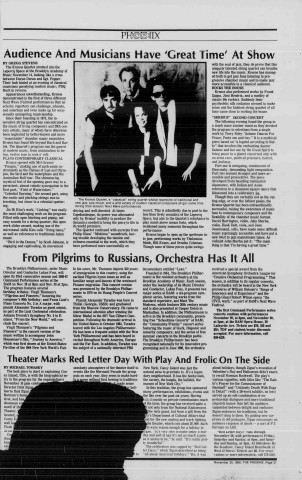
PKC%u2122MIXAudience And Musicians Have 'Great lime' At ShowThe Kronos Quartet, a %u201cclassical%u201d string quartet whose repertoire of traditional andnew jazz, pop music, and a wild variety of modem classical composers all got some timeduring their eclectic Next Wave performances.BY GREGG STEVENSThe Kronos Quartet strutted into the Lepercq Space at the Brooklyn Academy of Music November 14, looking like a cross between Duran Duran and Sgt. Pepper. Their look hinted at an evening of classical musicians parodying modem music; PDQ Bach in reverse.Appearances notwithstanding, Kronos demonstrated in the first of three different Next Wave Festival performances that an eclectic repertory can challenge, educate, and entertain and even make up for occasionally uninspiring musicianship.Since their founding in 1973, the innovative string quartet has concentrated on the music of living composers and 20th century artists, many of whom have otherwise been neglected by better-known and more %u201crespectable%u201d chamber music ensembles. Kronos has found life beyond Bach and Bartok. The Quartet%u2019s program ran the gamut of modern music, from minimalism to bebop, twelve tone to rock n%u2019 roll.PLAYS CONTEMPORARY CLASSICALKronos opened with Mel Graves%u2019 %u201cPangea,%u201d making use of such exotic instruments as the Chimes of Lun and Olympos, the bird and the waterphone and the Australian Bull roar. The shimmering mystical feel of the opening gave way to a persistent, almost robotic syncopation in the first part, %u201cField of Watercolors.%u201d%u201cCelestial Uprising,%u201d the second part, using the exotic and plucking strings was interesting, but closer to a celestial sputtering.Jin Hi Kim%u2019s work, %u201cLinking%u201d was easily the most challenging work on the program. Filled with open blurbing and piping, not easy sounds for a string quarter, this open work slides around, making use of the microtonal shifts Kim calls %u201cliving tones,%u201d as well as references to traditional Asian music.%u201cBird in the Domes,%u201d by Scott Johnson, is engaging and captivating, its movementdriving and well-directed. At times Copelandesque, its power was attenuated only by Kronos%u2019 inability to produce the dynamics needed to bring the piece to life in its world premiere.The Quartet continued with excerpts from Philip Glass%u2019 %u201cMishima%u201d soundtrack, having trouble developing the tension and richness essential to the work, which they have performed more successfully onrecord. This is admittedly due in part to the less than lively acoustics of the Lepercq Space, but also to the Quartet%u2019s reluctance to play much above mezzo forte, which weakened many moments throughout the performance.Kronos began to open up the spectrum into jazz, performing works by Thelonious Monk, Bill Evans, and Ornette Coleman. Though none of these pieces quite swingswith the soul of jazz, they do prove that this uniquely talented string quartet can breathe new life into the music. Kronos has managed both to get jazz fans listening to progressive chamber music and to make jazz more accessible to a classical audience. ROCKS THE HOUSEKronos also performed works by Frank Zappa, Jimi Hendrix, and a medley of classic 50s rockers. Suddenly their psychedelic silk costumes seemed to make sense and the funkiest string quartet of all time came close to rocking the house.%u201cSERIOUS%u201d SECOND CONCERTThe following evening found the group in a much more somber mood as they devoted the program to selections from a single work by Terry Riley %u201cSalome Dances For Peace, Parts one and two.%u201d It is a mythical piece based on %u201ca legend according to Buffo%u201d that involves the enchanting dancer Salome and her use by the Great Spirit to bring peace to a planet concerned only with an arms race, political prisoners, hatred, and jealousy.Part one is intriguing, reminiscent of Stravinsky, demanding tight composition. Part two seemed stronger and more accessible and provocative. The piece developed from haunting minimalist dissonance, with Indian and Asian references to a dissonant square dance that blossomed into a celebratory jig.Thougli they are certainly not on the cutting edge, or even the loftiest peaks, the Kronos Quartet has been extraordinarily successful, raising the awareness of music fans to contemporary composers and the flexibility of the chamber music format. David Harrington, violin, John Sherba, violin, Hank Dutt, viola, and Jean Jeanrenaud, cello, have made some difficult music suprisingly accessible and have put a new twist to jazz mainstream tunes. As violinist John Sherba put it: %u201cThe main thing is that I%u2019m having a great time.%u201dFrom Pilgrims to Russians, Orchestra Has It AllThe Brooklyn Philharmonic, under Music Director and Conductor Lukas Foss, will open its 33rd consecutive season and 1986-87 Command Performance series at the BAM on Nov. 28 at 8pm and Nov. 30 at 2pm. The program features several birthday tributes: Virgil Thomson%u2019s %u201cPilgrims and Pioneers,%u201d honoring the composer%u2019s 90th birthday; and Franz Liszt%u2019s Piano Concerto No. 2 in A major, with pianist Alexander Toradze as guest soloist, as part of the Liszt Centennial celebration. Antonin Dvorak%u2019s Symphony No. 5 in E minor, %u201cFrom the New World,%u201d will conclude the concert.Virgil Thomson%u2019s %u201cPilgrims and Pioneers%u201d is the concert version of the music written to accompany John Houseman%u2019s film, %u201cJourney to America,%u201d which was first shown at the United States Pavilion of the 1964 New York World%u2019s Fair.In his score, Mr. Thomson depicts 350 years of immigration to this country, using the earliest Pilgrim hymn tunes as well as familiar songs and dances of the westward Pioneer migration. This concert version was premiered by the Brooklyn Philharmonic in 1979 on its Young People%u2019s Concert series.Pianist Alexander Toradze was bom in Tbilisi (Georgia, USSR) and graduated from the Moscow Conservatory. He came to international attention after winning the Silver Medal in the 1977 Van Clibura Competition. Following his dramatic arrival in the United States in October 1983, Toradze toured with the Los Angeles Philharmonic. He has been a frequent soloist with the New York Philharmonic and has been heard in recital throughout North America, Europe and the Far East. In addition, Toradze was the subject of a nationally televised PBSdocumentary entitled %u201cLexo.\Founded in 1954, The Brooklyn Philharmonic is the resident orchestra at the Brooklyn Academy of Music. Each season, under the leadership of its Music Director and Conductor, Lukas Foss, it presents two major series at BAM: a six-program symphonic series, featuring works from the standard repertoire, and Meet The Modems, which features 20th century music and is also presented at Cooper Union in Manhattan. In addition, the Philharmonic is active in the Brooklyn community, presenting free %u201cSchooltime Concerts%u201d at BAM; the %u201cCommunity/Family%u201d concert series featuring the music of black, Hispanic and minority composers; and the series of free summer concerts in the Brooklyn parks.The Brooklyn Philharmonic has been recognized nationally for its innovative programming and in June 1986, the orchestrareceived a special award from the American Symphony Orchestra League for %u201cCreative Orchestral Programming.%u201d This season, in addition to its regular concerts, the orchestra will be heard in the New York premieres of William Bolcom%u2019s %u201cSongs of Innocence and of Experience%u201d and the Philip Glass/Robert Wilson opera %u201cthe CIVIL warS,%u201d as part of BAM%u2019s Next Wave Festival.The first Command Performance series concerts continue with performances November 29, at 8pm, and November 30, at 2pm, at the BAM Opera House, 30 Lafayette Ave. Tickets are $20, $16 and $10; TDF and student/senior discounts accepted. For more information, call 636-4120.Theater Marks Red Letter Day With Play And Frolic On The SideBY MICHAEL TOMASKYThe best place to start in explaining Coney Island, USA, is with the biographical entry in the program for the organization%u2019s November 15 gala celeb]Director Dick Zig learns that Barnuffi%u2019s homi ticut, and showman motif of th Theater, located,Coney wall b Fleshsawdusty atmosphere of the theater itself to events like the Mermaid Parade the group puts on each year, they seem to make hardly. a m ove without first bowing to traditionsade sense %u25a0 holiNew York, Coney Island was just the natural area to gravitate to. It%u2019s a legendary neighborhood. It has the honky-tonk, the carney, the hoopla, the bullshit, the masses of New York City.%u201dIn this tradition, the group has sponsored many performances, exhibitions, events and the like over the past six years. Having livd mostly on private contributions much the time, the group has received quite a t not only from the National Endowment ^ the Arts grant, but from a gift from the Jty%u2019s Department of Cultural Affairs that aid for the new seating and track lighting L he theater, which cost about $7,000. Such ts were reason enough for a holiday to izagun. It's very nice to make today a holiday and sort of say it%u2019s not as much a pain as it seems to be,%u201d he said. %u201cIt%u2019s really pretty wonderful.%u201dThe celebration was capped by %u201cRed le tter Days,%u201d which Zigun described as being %u201call about American holidays.%u201d Yes, it v/asabout holidays, though Zigun%u2019s evocation of Valentine%u2019s Day and Halloween didn%u2019t exactly recall Norman Rockwell. The play%u2019s various vignettes, with titles like %u201cThe Rabbi%u2019s Prayer for the Commissioner of Baseball%u201d and %u201cUntimely Death With Dogs in Detail%u201d (with a 28-word subtitle, no less) served up an odd combination of experimental dialogues and more traditional slapstick humor that left the audience suspended between delight and confusion. Zigun embraces his traditions, but he doesn%u2019t cling to them. By putting new surprises in old packages, Zigun encourages an audience response of shock %u2014 a sort of P.T. Bamum on LSD.\November 30, with performances Friday, Saturday and Sunday, at 8pm, and Saturday and Sunday, at 4pm. At Sideshows By the Seashore, Coney Island Boardwalk at West 12 Street. Tickets are $6. For reservations or more information, call 372-5159.lilN ^ ^ n b e ^ M 9 8 6 ^ ^ lr P ^ E N ! T ^ ^ ^


