


Page 335 - Demo
P. 335
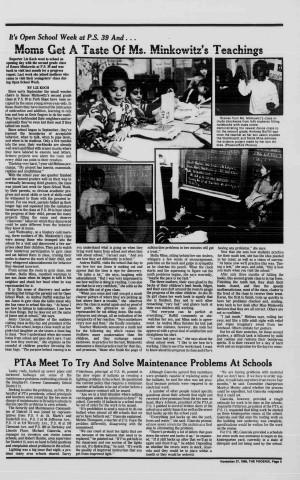
It's Open School Week at P.S. 39 And . . .A T a o I a r \\ f l i f c M in L rA u rif7 ^ e ' I A 9 ^ liitiflr ci T I V l I I O n JL U O t V V / A A f A O %u00ab i l A A i m v m v u v 2 v m w m u ^ vReporter Liz Kocb went to school onopening day with the second grade classof Renee Minkowitz at P.S. 39 and wasback to visit last month for a progressreport. Last week she joined mothers whocame to visit their youngsters%u2019 class during Open School Week.BY LIZ KOCHSince early September the small woodenchairs in Renee Minkowitz%u2019s second gradeclass at P.S. 39 in Park Slope have been occupied by the same young seven-year-olds. Inthese chairs they have learned the intricaciesof subtraction and addition, learning to relyless and less on their fingers to do the math.They have befriended their neighbors and occasionally they%u2019ve even lost their seat if theytalked too much.Since school began in September, they%u2019velearned the boundaries of acceptablebehavior, when to talk, when to pipe down,and when to be studious. Only a few monthsinto the year, their workbooks are alreadywell worn and filled with eraser marks wherethey have labored to execute neat letters.Science projects now adorn the room andevery child can point to their creation.Thinking very hard, 7-year old Melissa proclaims, %u201cMy project has insects, mammals,reptiles and amphibians.%u201dWith the school year one quarter finishedand the second graders well on their way toeventually becoming third graders, the classwas joined last week for Open School Week,by their parents, so obvious academic progress and social skills or lack of skills couldbe witnessed by those with the greatest interest. For one week, parents folded up theirlonger legs and squeezed into the miniaturefurniture in the class at P.S. 39 to hear aboutthe progress of their child, peruse the manyprojects filling the room and observe%u201cclassroom%u201d behavior which they discoveredcould be quite different from the behaviorthey know at home.Last Wednesday, on a blustery cold morning, three mothers of Ms. Minkowitz%u2019s classwere among those who tromped into theschool for a visit and discovered a few surprises about their children. They got to watchtheir boisterous participation in gym classand sat behind them in class, craning theirnecks to observe the work of their child, andthey whispered admonishments for behaviorthey deemed incorrect.From across the room in gym class, onemother, Stella Mina, mouthed warnings toher son Jason when he began to talk to hisneighbor and shook her head when he wasreprimanded for it.It is this sense of discovery and understanding that brings the parents out for OpenSchool Week. As Andres Buffill watches herson Jason in gym class she talks about whyshe has come to school this day. %u201cAt home Isee how he listens to instructions. I see howhe does things. But he does not act the sameat home and at school,%u201d she says.Jenny Carcaci, another of the mothersvisiting class on this day and president of thePTA at the school, keeps a close watch on herpink-clad daughter as she tosses a bean bagin class. %u201cNow I understand when she comeshome from school and says she%u2019s sore. I cansee how they exercise,%u201d she explains as theroomful of children practice throwing thebean bags. %u201cThe purpose behind coming is soScenes from Ms. Minkowitz%u2019s class include (clockwise from left) students fillingnotebooks with class notes;demonstrating the newest dance craze tohit the second grade; Andreas Buffill watches the teacher as her son Jason studiesthe blackboard; and Stella Mina admiresthe science project made by her son Andres. (Phoenix/Kirk Photos).you understand what is going on when theybring work home from school and when theytalk about school,%u201d Carcaci says. %u201cAnd yousee how they act differently in school.%u201dAndres Buffill, visits the school that day tosee how her son Jason is making out andagrees that the time is ripe for discovery.%u201cHe talks a lot,%u201d she says, laughing withastonishment. %u201cBut I was very impressed tosee how well he is doing in reading. I can alsosee that he is very confident,%u201d she adds as thestudents file out of gym class.%u201cWhen you come and visit you get a muchclearer picture of where they are picking upfast where there is trouble,%u201d she observesonce the class is seated again and as proof ofher point, she grimaces as Jason isreprimanded for not sitting down. She nods,grimaces and shrugs, all an indication of thecomplexity of her reaction. %u201cBoys misbehaveevery now and then,%u201d she finally concludes.Teacher Minkowitz announces a math testfor the following day which causes themothers more consternation than thechildren, and they exchange raisedeyebrows. As practice for the test, Minkowitzannounces a timed practice test for that day,and promises, %u201cthose who finish the page ofsubtraction problems in two minutes will geta treat.%u201dStella Mina, sitting behind her son Andres,whispers a few words of encouragement,pats him on the back and gulps in sympathyas he clutches his pencil. When the clockstarts and the squirming to figure out themath problems begins, she says worriedly,%u201cmaybe the pace is too fast.%u201dThe three mothers, their eyes glued to thebacks of their children%u2019s bent heads, fidget,and their eyes dart around the room to gaugethe progress of the other children. As one little girl closes her work book to signify thatshe is finished, they nod to each otherremarking %u201cvery fast%u201d and glance back attheir own children still working.%u201cNot everyone can be perfect ateverything,%u201d Buffill comments as shewatches her son, and Mina nods in agreement. As Andres Mina finishes his test justunder two minutes, however, she nods herapproval with a great deal of satisfaction andstraightens his shirt.%u201cI came last year too,%u201d she says about theabout school week. %u201cI like to see how he%u2019sworking. I like to see if he works hard. I wantto know about his progress in class and if he%u2019shaving any problems,%u201d she says.Now that she sees how students practicefor their math test, she has the idea plantedin her mind, as well as a vision of success.%u201cAt home now we%u2019ll practice this way. Timing a test,%u201d she says, and adds, %u201cthis is howyou learn when you visit the school.%u201dAfter only three months of hitting thebooks, this second grade class is in top form.Finishing the math test, they slam theirbooks closed, and then the speedymathematicians, most of the class, cluster tothe front of the class to receive their treat.Karen, the first to finish, trots up quickly tohave her problems checked and, smiling,trots back to her desk after Miss Minkowitzdeclares that they are all correct. Others arenot so confident.%u201cI just made,%u201d Melissa says, rolling hereyes, and like a little adult sighs with reliefand wipes imaginary sweat from herforehead. Others imitate her gesture.But for all their anxieties, for these secondgraders, a difficult task is followed by milkand cookies and restores their boisterousspirits. It is their reward for a day of hardwork and an inspiration for the days to come.PTAs Meet To Try And Solve Maintenance Problems At SchoolsLeaky roofs, backed up sewer pipes anddarkened hallways are some of themaintenance problems confronting schools inthe Heights-Ft. Greene Community SchoolDistrict 13.Seeking to solve the problems, on Nov. 20 ahandful of PTA presidents, school principalsand teachers were joined by the two men incharge of maintenance in Brooklyn schools todiscuss specific problems in area schools.The Security and Maintenance Commmittee of District 13 was joined by representatives from P.S. 9 at St. Mark%u2019s andUnderhill Ave., P.S. 3 at 50 Jefferson Ave.,P.S. 11 at 419 Waverly Ave., P.S. 46 at 100Clermont Ave. and P.S. 282 at Berkeley andLincoln Place. Michael Giancola, aream a n a g e r to r B ro o k ly n a n a S ta te n is la n dschools, and Robert Hanlon, area supervisorfor District 13, were on hand to field questionsand complaints about problems in the school.Lighting was a big issue that night, a problem many area schools shared. BarryFinkelman, principal at P.S. 46, pointed tothe slow repair of ballasts as creating alighting problem in his school. He questionedthe current policy that requires a minimumnumber of ballasts to be out of order before amaintenance contract will be issued.%u201cAre we in a bind situation where nothingcan happen unless the minimum is done?%u201d heasked. Currently 10 ballasts in a school mustbe out of order for the work to be issued.%u201cIt%u2019s prohibitive to send a man in to do oneballast when almost all 400 schools that weserve have ballasts out,%u201d Giancola explained.Melvin Thompson, a teacher at P.S. 9 saw theproblem differently, disagreeing with theassessment.%u201cWe can count at least ten lights that areout because ot tne ballasts that need to bereplaced,%u201d he pointed out. %u201cIf I%u2019ve got kids inthe classroom and one section of the lightsare out, it%u2019s distracting,%u201d he said. %u201cIt%u2019s worththe quality of improved instruction that youget from improved light.%u201dAlthough Giancola agreed that custodianswere probably capable of replacing some ofthe ballasts, he said the idea was not practical because permits were required to doelectrical work.A number of other people raised specificquestions about their schools that night andreceived a few promises from the two men onhand. Mary Johnson, president of the PTA atP.S. 3 pointed to several broken doors at theschool as a safety hazard as well as the sewerthat backs up into the school yard.%u201cEverything just backs up into the yard,feces and water,%u201d she said. Giancola promised new sewer covers for the system as a firststep to eliminating the problem.%u201cThere%u2019s probably a lot of debris that goesdown the sewer and backs it up,%u201d he explained. %u201cIf it still backs up after that we%u2019ll go inagain and clean it up,%u201d he added. Dependingon whether the covers were in stock, Giancola said they would be in place within amonth or they would be ordered.%u201cWe are having problems with materialthat we don%u2019t have. If we have to order supplies, it could take anywhere from two to fourmonths,%u201d he said. Committee chairpersonMarilyn Mosley asked whether the processcould be expedited, but Giancola respondedthat it could not.Giancola, however, provided a roughestimate for work to be done on the schools.Jeannette Patterson, president of the PTA atP.S. 11, requested that tiling work be startedon three kindergarten rooms at the school.Giancola said that once the roofing work onthe building now underway was complete,specifications would be written for the workon the rooms.For P.S. 282, Giancola provided a schedulefor when work was estimated to begin on tnekindergarten yard, currently in a state ofdisrepair and not being used by the school.November 27,1986, THE PHOENIX, Page 3


