


Page 371 - Demo
P. 371
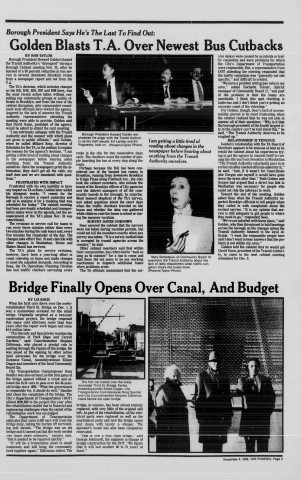
Borough President Says He9s The Last To Find Out:Golden Blasts T,A. Over Newest Bus CutbacksBridge Finally Opens Over Canal, And BudgetBY ROB TAYLORBorough President Howard Golden blasted the Transit Authority%u2019s %u201cdisregard%u201d during a Borough Cabinet meeting Nov. 25, after he learned of a 50 percent reduction in bus service to several downtown Brooklyn routes from a newspaper report and not from the T.A.The TA%u2019s decision, which includes changes on the B41, B49, B55, B67 and B68 lines, was the most recent action taken without consulting any community groups or public officials in Brooklyn, and from the tone of the cabinet discussion, only compounded resentment local officials have toward the agency. Angered by the lack of answers the Transit Authority representatives attending the meeting were able to provide, Golden said that David Gunn, president of the agency, would be asked to attend the next meeting.%u201cI am extremely unhappy with the Transit Authority and the manner with which plans are given to public officials,%u201d said Golden, when he called Millard Seay, director of Schedules for the TA, to the podium to explain the reasons for the agency%u2019s decision. %u201cI am getting a little tired of reading about changes in the newspaper before hearing about anything from the Transit Authority ourselves. Once the newspapers print the information, they don%u2019t get all the calls, my staff does and we are inundated with questions.%u201dFRUSTRATED WITH IMPACTFrustrated with his own inability to have any impact on TA actions, Golden later added his strongest words, %u201cI resent for the Borough to receive a report yesterday and ask us to analyze it for a meeting that was scheduled for today.%u201d The cabinet meeting had been previously scheduled and transportation issues were on the agenda, but the announcement of the TA%u2019s plans Nov. 24 was coincidental.The revisions in service call for buses to run every three minutes rather than every two minutes during the rush hours and, every five minutes the remainder of the day. The changes take effect Dec. 15 and coincide with other changes in Manhattan, Bronx and Staten Island bus services.The TA%u2019s plans for service revisions, however, have been a year-long effort to count ridership on buses and make changes to meet the adjusted demands. According to Seay, the TA Operations Planning Division has had traffic checkers surveying everyBorough President H ow ard Golden e m %u00adphasizes his anger w ith th e Transit A u th o rity as his s ta ff people, Ed Landau and EdR ogow sky, look on. (Phoenix/Taylor Photo)route in the city for two consecutive days each. The checkers count the number of people boarding the bus at every stop along the route.Perhaps because the B41 has been considered one of the busiest bus routes in Brooklyn, running from downtown Brooklyn to Kings Plaza along Flatbush Ave., the cuts took the cabinet members, who include the heads of the Brooklyn offices of City agencies and the district managers of all the community boards in the borough, by surprise. Most seemed skeptical of the TA%u2019s survey, and asked questions about the exact days when the traffic checkers traveled on the buses and whether the data was gathered while children rode the buses to school or during the summer vacation.SURVEY DATES UNKNOWNSeay assured the cabinet that the surveys were not taken during vacation periods, but could not tell the members exactly when any survey was taken. %u201cIt is a survey method that is accepted by transit agencies across the country,%u201d he said.Other cabinet members said that within their communities, bus riders had to %u201cwait as long as 45 minutes%u201d for a bus to come and that there did not seem to be any working mechanism to dispatch additional buses when problems arose.The TA officials maintained that the service delays were caused by accidents or traffic conjestion and were problems for which the City%u2019s Department of Transportation were responsible. But, a representative from DOT attending the meeting responded that the traffic conjestion was %u201cgenerally not site specific,%u201d and difficult to control.%u201cWe have a problem with gypsy cabs in my area,%u201d added Rochelle Tenner, district manager of Community Board 17, %u201cand part of the problem is that the buses are unreliable. I think this spot checking is ludicrous and I don%u2019t think you%u2019re getting an accurate count of the ridership.%u201dFor Golden, though, Seay%u2019s lack of accountability proved to be most frustrating when the cabinet realized that he was not able to answer all of their questions. %u201cWhy is it that the borough president of the fourth largest city in the country can%u2019t be told about this,%u201d he said. %u201cThe Transit Authority deserves to be roughed up.%u201dRELATIONSHIP IS TENUOUSGolden%u2019s relationship with the TA Board of Directors appears to be tenuous at best as he retold the cabinet about his experiences trying to get the agency to commit itself to running the B51 bus from Brooklyn to Manhattan. %u201cThe Transit Authority reluctantly gave in to a trial run after elected officials asked for it,%u201d he said. %u201cAnd, if it wasn%u2019t for Councilman Abe Gerges and myself it would have gone down the drain after that.%u201d Both Golden and Gerges had argued that a direct bus link to Manhattan was necessary for people who could not ride the subways to work.Toward the end of the meeting, Golden asked Seay what the Transit Authority expected Brooklyn officials to tell people when they called in with complaints about the revised service. %u201cIt is my opinion that service is still adequate to get people to where they need to go,%u201d responded Seay.%u201cWe%u2019re not satisfied with these plans,%u201d said Golden, who then threatened to hold hearings across the borough on the changes unless the Transit Authority listened to the local officials. %u201cI want the responsible people here and I don%u2019t want to hear answers that the problem is not within my area.%u201dGolden told the cabinet that he would get David Gunn, president of the Transit Authority, to come to the next cabinet meeting scheduled for Dec. 9.BY LIZ KOCHWhen the first cars drove over the newlyrehabilitated Third St. Bridge on Dec. 1, it was a momentous occasion for the small bridge. Originally targeted as a two-year construction project, the bridge reopened this sunny cold afternoon more than four years after the repair work began and some $4-6 million later.%u201cThis literally and figuratively reunites the communities of Park Slope and Carroll Gardens,%u201d said Councilmember Stephen DiBrienza, who played a pivotal role pushing through the repairs of the bridge. He was joined at the opening by other active local advocates for the bridge over the Gowanus \Dugan and members of the local Community Board Six.City Transportation Commissioner Ross Sandler was also on hand, as the first gates of the bridge opened without a creak and allowed the first cars to pass over the 81-yearold bridge since 1982. %u201cWhat the government is responsible for, it should do well,%u201d Sandler said about the completion of the bridge. The City%u2019s Department of Transportation (DOT) alloted $500,000 to the project this year after the rehabilitation stalled due to financial and engineering challenges when the extent of the rehabilitation work was misjudged.The Department of Transportation estimates that some 6,420 cars will cross the bridge daily, taking the burden off surrounding side streets. %u201cThe bridge was an old bridge and it turned out that the work needed was mucn more extensive,:: Sandier saiu. %u201cBut it needed to be repaired quickly.%u201d%u201cIt will be a tremendous asset to small businesses and will bring the community back together again,%u201d DiBrienza added. TheThe first car travels over the newlyrenovated Third St. B ridge. Earlier, 'A ssem blyw om an Eileen D ugan, CityT ransportation C o m m issio n er Ross S an d lerand City C ou n cilm em b er Stephen D iB rien zas tan d before the open bridge.bridge, in essence, has been almost entirely replaced, with very little of the original still left. As part of the rehabilitation, all the electrical parts were replaced as well as the mechanical parts and now the bridge opens and closes with barely a whisper, operator%u2019s house has also been completely renovated.%u201c This is now a first ciass bridge,:: said George Adelhardt, the engineer in charge of bridge construction for the DOT. %u201cWe figure that it will last another 50 to 75 years at least.%u201dI am getting a little tired ofreading about changes in thenewspaper before hearing aboutanything from the TransitAuthority ourselves.M ary S em p epos, of C om m unity Board 10,questions th e T ransit A uthority abo u t thelack of radio disp atchers when traffic congetion slow s th e buses down.(P hoenix/Taylor Photo)D ecem ber 4, 1986, TH E P H O E N IX , Page 3


