


Page 375 - Demo
P. 375
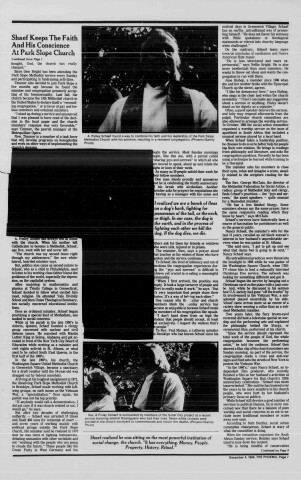
Shaef Keeps The FaithAnd His ConscienceA I C l____ n\\______1_ m i w in . u i u p c V / i i u i u iContinued from Page Ithought, God, the church has really changed.%u201dSince then Bright has been attending the Park Slope Methodist service every Sunday and participating in fundraising activities.Timmer also decided to join Park Slope a few months ago because he found the minister and congregation genuinely accepting of his homosexuality. Last fall, the church became the 14th Methodist church in the United States to declare itself a %u201creconciling congregation,%u201d or in favor of gay and lesbian members and ordained ministers.%u201cI stood up during a service and announced that I was pleased to have read of the decision in the local paper and the church members%u2019 response was very favorable,%u201d says Timmer, the payroll manager at the Metropolitan Opera.Now, Timmer is a member of a task force that will develop programs on homophobia and work on other ways of implementing theomeotwith the church. When his mother left Catholicism to become a Methodist, Schaef, age five, went with her and never left.%u201cThe church was my second home right through my adolescence,%u201d the now whitehaired, bearded minister says.But, politics also came as second nature to Schaef, who as a child in Philadelphia, used to listen to his working class father blame the problems of the world, especially the depression, on the capitalist system.After majoring in mathematics and physics at Trinity College in Connecticut, Schaef decided to follow what excited him most, religion. He attended Yale Divinity School and then Union Theological Seminary, two socially concerned educational institutions.Once an ordained minister, Schaef began practicing a special kind of Methodism, one soaked in social concerns.While at his parish in the late 1950%u2019s in Astoria, Queens, Schaef founded a clergy group concerned with nuclear and civil defense issues. He marched with Martin Luther King in Selma, Alabama and got arrested in front of the New York City Board of Education while working as a minister and civil rights activist in St. Albans, or what used to be called South East Queens, in the first half of the 1960%u2019s.In the late 1960%u2019s, his church, the Washington Square United Methodist Church in Greenwich Village, became a sanctuary for a draft resistor until the 18-year-old was dragged out by federal marshals.Arriving at his toughest assignment in 1972, the dissolving Park Slope Methodist Church in Brooklyn, Schaef made working with leftwing groups, on such issues as the Vietnam War, a %u201cspecialization.%u201d Once again, his parish was not his top priority.%u201cIf anybody would call a demonstration, I did not care if it was church related or not, I would go,%u201d he says.But after two decades of challenging authority %u2014 Schaef was arrested 13 times and fined $50 once for contempt of court %u2014 and seven years of working mainly with political groups outside the Park Slope church, the minister said he realized in 1979 tnat ne was tired ot tignting bureaucrats, debating semantics with other socialists and not %u201cworking with the people who are going to create the future.%u201d These people like the Green Party in West Germany and theA. F in ley S ch aef found a way to c o m b in e his faith and his leadership of th e Park SlopeM e th o d is t C hurch w ith his activism , resulting in a renew ed congregation. (P hoenix/G arrityPhoto)gin the service. Most Sunday mornings gin, like this one, with a period called sharing joys and sorrows%u201d in which all who re moved to speak, stand up and relate the ighs or lows of their week.As many as 20 people unfold their week for eir fellow members.One man stands proudly and announces it he is celebrating the fourth anniversary his break with alcoholism. Another ember asks for prayers for negotiations she having as a manager with her union andI realized we are a bunch of fleason a dogs back, fighting forpossession of the tail, or the neck,or thigh. In our case, the dog isthe earth, and in the process offighting each other we kiil thedog. If the dog dies, we die.ithers ask for them for friends or relatives ho were sick, injured or in prison.The minister, then, says a prayer aloud at touches on the wishes of those who have poken and the service continues.To Schaef, the level of intimacy and run of motions the congregation experiences durig the %u201cjoys and sorrows%u201d is difficult to chieve yet crucial in creating a meaningful immunity.%u201cWhen I first arrived, the practice was pty. It took a large turnover of people and ffort to really make it work,%u201d he says. %u201cBut ,%u2019s very important that people share their lories. It%u2019s a way of heHng each other.%u201d One reason why th astor and church embers think the onday service has ome so enjoyable is because Schaef treats e members of his congregation like equals. %u201cI don%u2019t hand down from on high the lorn that people should accept, at least exclusively. I respect the wisdom that%u2019s people.%u201dTo Rev. Paul Matson, a Lutheran minister Brooklyn who has known Schaef since hisRev. A Finley S ch ae f is surrounded by m em bers of the Sister City project at a recentservice honoring several N icaraguans w ho lost their lives. Seven w h ite crosses wereplanted in the church courtyard to com m em orate and m ourn the deaths. (P hoenix/G arrityPhoto)Shaef realized he was sitting on the most powerful institution ofsocial change, the church. %u201cIt has everything. Money. People.Property. History. Ritual. %u201dactivist days in Greenwich Village, Schaef has an earthy, untraditional way of presenting himself. %u201cHe does not flavor his sermons with Bible quotations or theological statements or retreat into churchy language when challenged.%u201dOn the contrary, Schaef leans more Luwaius interludes in meditation dim Native American flute music.%u201cHe is less structured and more experimental,%u201d says Nellie Bright. He is also more intellectual than most ministers. He wants to throw out ideas and wants the congregation to run with them.Jane Bishop, a member since 1980 when she and her mother broke with the Episcopal Church up the street, agrees.%u201cI like his democracy here,%u201d says Bishop, who sings in the choir and writes the church newsletter. %u201cI feel I can make any suggestion about a sermon or anything. Finley doesn%u2019t stand on his dignity as a minister.%u201dOften, a guest speaker delivers the sermon, and laity may respond afterwards from the pulpit. Particular church committees are also allowed to arrange the worship service. In October, 1985 the social action committee : organized a worship service on the issue of apartheid in South Africa that included a musical sermon played by a local band.When Schaef takes a leadership position, he chooses to do so as to better help his people tap their own wisdom. He brings in readings from philosophy and literature, and asks the congregation questions. Recently he has been using a technique he learned while training to be a therapist.The minister asks his members to close their eyes, relax and imagine a scene, usually related to the scripture reading for the day.The Rev. George McClain, the director of the Methodist Federation for Social Action, a radical group of Methodist laity and clergy, finds Schaef%u2019s practices %u2014 the %u201cjoys and sorrows,%u2019 the guest speakers %u2014 quite unusual for a Meinodist minister.%u201cHe has a less limited liturgy. Some ministers always say the same prayer, have the same responsive reading which they know by heart,%u201d says McClain.Schaef%u2019s services have historically been a source of fascination for parishioners as well as the general public.Nancy Schaef, the minister%u2019s wife for the last 12 years, recalled an old black woman%u2019s interest in her husband%u2019s unpredictable services when he was pastor at St. Albans.%u201cShe said once, %u2018I got to get up and see what that damn fool is going to do next,%u2019 %u201d Nancy Schaef says.His untraditional practices were thrust into the limelight in 1966 while he was pastor of the Washington Square Church, when CBSTV chose him to lead a nationally televised Christmas Eve service. The network was looking for something different and got it.Schaef began the service by banging out a Christmas carol on the piano with a jazz combo. And, while he discussed in his sermon how U.S. society had gone %u201coff the tracks%u201d by its involvement in the Vietnam War, a saxophonist played mournfully by his side. Schaef came across more as an emcee of a variety show wearing a collar than as a subdued Methodist minister.Two years later, the fiery brown-eyed reverend did host a television special on worship and the performing arts and explained the philosophy behind the liturgy, or ceremonial rites, performed at his church.%u201cSince the service should represent the total work of the people of God, the whole congregation becomes the performing artist,%u201d he told the audience. Schaef then showed a film clip of his church members one Sunday morning. As part of the service, the congregation made a cross and anti-war signs and filed onto the streets of New York to protest the Vietnam War.%u201cIn the 1960%u2019s,%u201d says Nancy Schaef, an independent film producer, who recently finished a film on her husband%u2019s activities at Square for that church%u2019s 125th celebration. %u201cSchaef was more %u201d She said he has learned over the years to be more sensitive to his church people, who were hurt by her husband%u2019s primary focus on politics.While Schaef still devotes a good number of services to political themes, he is more concerned now that there be a balance of pure worship and social concerns so as not to exclude more traditional members or scare away new ones.According to Beth Bentley, social action committee chairperson, Schaef is wary of what the committee is doing.When iiie cununiuee organized die South Africa Sunday service, Bentley says Schaef tried to tone down the content.%u201cHe is being mindful of conservative Continued on Page 8D ecem ber 4, 1986, TH E P H O E N IX , Page 7


