


Page 393 - Demo
P. 393
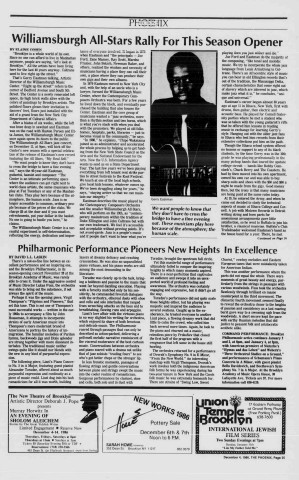
PHC'SrflXWilliamsburgh All-Stars Rally For This Season OpenerRV ELAINE COHEN%u201cBrooklyn is a whole world of its own. Since no one can afford to live in Manhattan anymore, people are saying, %u2018let%u2019s look at Brooklyn.%u201d All the artists have been living here for the last 40 years anyway. Coltrane used to live right up the street.%u201dThat%u2019s Gerry Eastman talking, Artistic Director of the Williamsburgh Music Center. %u201cRight up the street%u201d refers to the comer of Bedford Avenue and South 5th Street. The Center is a newly renovated loft space, its high brick walls alive with the colors of paintings by Brooklyn artists. The polished floors gleam their invitation to dancers%u2019 feet, floors just installed with the aid of a grant from the New York City Department of Cultural Affairs.After a hiatus of six weeks, while the loft was knee deep in sawdust and Eastman was on the road with Huston Person and Etta James, the Williamsburgh Music Center once again opens its doors to the public.The Williamsburgh All Stars jazz concert, on December 13, at 9pm, will kick off the Center%u2019s new season with a special celebration of the release of Eastman%u2019s new record featuring the All Stars, %u201cMy Real Self.%u201d%u201cWe want people to know they don%u2019t have to cross the bridge to have a fine evening out,%u201d says the 40-year-old Eastman, guitarist, bassist and composer. %u201cThe Center is an intimate performing space where the audience can get right next to world class artists, the same musicians who play at Fat Tuesdays or any of the Manhattan clubs. They play here because of the atmosphere, the human scale. Jazz is no longer accessible to common, ordinary people because of the prices of the clubs. We charge $5 at the door and if you want refreshments, put your dollar in the basket. No one is going to hustle you here,%u201d he claims.The Williamsburgh Music Center is a successful experiment in self-determination, reflecting the energy, dedication and imporuiiiuc ui everyone UlVOlVcu. n uegau in 1373when Eastman and %u201cthe principals %u2014 Joe Ford, Zane Massey, Ray Scott, Marsha Frazier, John Betsch, Newman Baker, and others, realized the wisdom and necessity of musicians having a place they can call their own, a place where they can produce their own gigs and their own albums.In 1979 Eastman moved to New York City and, with the help of an uncle who is a lawyer, formed the Williamsburgh Music Center, where the Contemporary Composers Orchestra was bom. For a few years he lived down the block, and eventually purchased the building that also houses the Center. Eastman and the core group of musicians wanted a %u201cjazz orchestra, more than a rhythm section and two horns, which is what you%u2019re stuck with when you deal with the promoters. We played at old folks homes, hospitals, parks, libraries %u2014 just to become visual in the community,%u201d he says.%u201cIn 1980,%u201d he explains, %u201cChipo Wakatama joined us as administrator and accelerated the whole process by helping us to get funding from the New York State Council on the Arts and the National Endowment for the Arts. Now the U.S. Information Agency wants to send us on a State Department Tour. The last few years we%u2019ve been playing everything from loft tenant rent strike parties to street festivals to the Kool Festival. We teach at one of the local high schools, give local kids lessons, whatever comes up. We%u2019ve been struggling along for years,%u201d he says, %u201cstaying active so that we can maintain our integrity.%u201dEastman describes the music played by the Contemporary Composers Orchestra and the smaller Williamsburgh All Stars, who will perform on the 13th, as %u201ccontemporary mainstream within the tradition of Duke Ellington and John Coltrane but with our own trademark. We feel it%u2019s accessible and acceptable without proving points. It's not avant-garde. Jazz is a people%u2019s music and if people don%u2019t want to hear what you%u2019reGerry Eastm anW e w an t p eo p le to k n o w thatthey d o n 't have to cross thebridge to have a fin e eveningout. These m usicians play h erebecause o f the atm osphere; th eh u m an scale.playing then you just wither and die.%u201dJoe Ford and Eastman do the majority of the composing, %u201clike tonal and melodic music. We try to incorporate the whole jazz language from Louis Armstrong to Coltrane. There%u2019s an Afrocentric style of music you can hear in old Ellington records that%u2019s out of the tradition, the Mississippi Delta, certain characteristics that come right out of slavery which are inherent in jazz, which make jazz what it is,%u201d he concludes, %u201cunique and universal.%u201dEastman%u2019s career began almost 30 years ago at age 11 in Ithaca, New York, first with drums, then guitar, then electric and acoustic bass. He played for Cornell fraternity parties where he met a student who was so taken with the young guitarist%u2019s riffs that he offered him lessons in reading music in exchange for learning Gerry%u2019s style. Hanging out with the older jazz fans in Ithaca who lent him records from their extensive collections put him on the path.Though the Ithaca school system offered no lessons or support to any of its black students, by the time Gerry was in the 10th grade he was playing professionally in the many pickup bands that toured the upstate college circuit %u2014 bands like Bobby Comstock%u2019s, Chuck Berry and The Coasters. He had by then moved into his own apartment, owned his own car and was able to buy sharp suits and shoes with the $50 and $60 a night he made from the gigs. Good money then, but the irony is that many musicians are being paid at the same rates today.At 19, he entered the Army, and when he came out decided to study the technical aspects of music at Ithaca College and Cornell. A job with Motown Records in Detroit writing string and horn parts for anonymous arrangements gave little satisfaction, so he went to Buffalo to join his brother, a classical musician. Buffalo%u2019s Club Trafalmador welcomed Eastman%u2019s band as the house band for a year. There, he metContinued on Page 26Philharmonic Performance Pioneers New Heights In ExcellenceBY DAVID L.L. LASKINThere%u2019s a not-so-fine line betwen an excellent performance and an inspiring one, and the Brooklyn Philharmonic, in its season-opening concert November 28 at the Brooklyn Academy of Music, was rarely able to cross it. Under the aggressive control of Music Director Lukas Foss, the orchestra was able to bring out the substance, if not always the spirit of the music.Perhaps it was the opening piece, Virgil Thompson%u2019s %u201cPilgrims and Pioneers,%u201d that set this tone. This is not one of Thompson%u2019s most successful works %u2014 written in the early 1960s to accompany a film by John Houseman, it attempts to incorporate strains of early American music into Thompson%u2019s more modernist brand of Americana to portray the history of immigration. The familiar melodies of Puritan hymns, backwoods jigs and Dixie splendor are strung together with more dissonant interludes. The traditional music neither swings quite like it should nor blends with the new in any kind of purposeful expression.The following piece, Liszt%u2019s Piano Concerto No. 2 in A Major, featuring guest pianist Alexander Toradze, offered about as much purposeful expression and continuity as a piece of music could. Liszt dug into his lush romanticism for all it was worth, buildinglayers of dreamy delicacy and crashing crescendoes. He was also an unparalleled piano virtuoso, and his piano works are still among the most demanding in the literature.Toradze was clearly up to the task, bringing a boldness and passion to the music that went far beyond dazzling execution. Playing with a ferocity matched only by his sensitivity, he commanded feverish dialogues with the orchestra, ethereal duets with oboe and cello and solo interludes that ranged from wrenching attacks on the bass end to breathtaking, flowing runs and arpeggios.Liszt%u2019s love affair with the virtuoso piano in no way slighted his writing for orchestra, which enjoyed its share of both ferocious and delicate music. The Philharmonic roared through passages that can only be described as action-packed, delivering a pell-mell melodic narrative reminiscent of the visceral exuberance of the best cartoon music. Conversations between orchestra and piano soared with a drama not unlike that of jazz soloists %u201ctrading fours%u201d to see who%u2019s got better chops or the stronger lip.In less frenetic moments, passages of flowing strings and gentle conversations between piano and strings swept the music into the cooler realms of romanticism. Gorgeous performances by clarinet, oboe and cello, both solo and in duet withToradze, brought the spectrum full circle.Yet this masterful range of performance ultimately failed to conquer the inspiring heights to which many moments aspired. There is a near-perfection that captivates an audience and sweeps it into an unexpected world of profound feeling and awareness. The orchestra was certainly engaging and expressive, but it didn%u2019t go all the way.Toradze%u2019s performance did not quite scale those heights either, but his playing was majestic and inspired the audience to several ovations. Caught up in the exuberance, he treated everyone to another Liszt piece, a flowing dreamy work that did little to calm the crowd, who called him back several more times. Again, he took to the piano and churned out a manic, relentless piece by Prokofiev that closed the first half of the program with a vengeance that left some in the house still howling.The orchestra returned for a performance of Dvorak%u2019s Symphony No. 9 in E Minor, %u201cFrom the New World.%u201d An interesting matchup with Virgil Thompson, Dvorak%u2019s work invokes both the indigenous American folk forms he was experiencing during his two-year tenure in New York and the Czech folk music he was extremely homesick for. There are strains of %u201cSwing Low, SweetChariot,%u201d cowboy melodies and Eastern European tunes that were mistakenly taken for American Indian.This was another performance where the parts did not equal the whole. There were moments of great beauty and energy, particularly from the strings in passages with various woodwinds. Foss took the orchestra flawlessly through brilliant en masse counterpoint in the third movement. The climactic fourth movement seemed finally to reveal the orchestra closer to the heights of passion and consistency as a last roaring burst gave way to a swooning sigh from the woodwinds. A short encore kept the pace with earthy Russian melodies that did justice to peasant folk and aristocratic aesthete alike.COMMAND PERFORMANCE: Brooklyn Philharmonic series continues January 2 and 3, at 8pm, and January 4, at 2pm, with American premiere of Nietzche%u2019s %u201cHymns and das Leben%u201d and Webern%u2019s %u201cThree Orchestral Studies on a Ground,%u201d and performances of Schumann%u2019s Piano Concerto in A Minor, with guest pianist Bella Davidovich, and Beethoven%u2019s Symphony No. 7 in A Major. At the Brooklyn Academy of Music Opera House, 30 Lafayette Ave. Tickets are $7. For more information call 6364120.The New Theatre of BrooklyiTArtistic Director Deborah J. PopepresentsM urray Horwitz In AN EVENING OF SHOLOM ALEICHEMStories by The Great Yiddish WriterLimited Engagement %u2022 Reserve Now December 4-14. 1986Thursdays, Fridays, Saturdays at 8pmThursdays at H a m %u2022 Sundays at 3pmTickets $8 (Saturday Evening $io) or TDF +Reservations: (718) 230-3366_ i_ _ _ <_ >Ji65_Dean>


