


Page 501 - Demo
P. 501
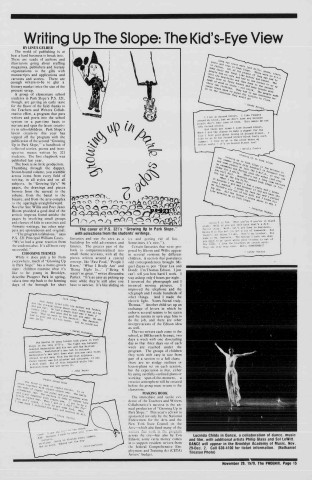
W r i t i n g U p T h e S l o p e : T h e K i d %u2019s - E y e V i e wBY LINUS GELBERThe world of publishing is at best a hard business to break into. There arc scads of authors and illustrators going about stuffing magazines, publishers and literary organizations to the gills with manuscripts and applications and cartoons and stories. There are enough writers-to-be to glut a literary market twice the size of the present setup.A group of elementary school students in Park Slope%u2019s P.S. 321, though, are getting an early taste for the flavor of the field thanks to the Teachers and Writers Collaborative effort, a program that puts writers and poets into the school system on a part-time basis to nurture and spur the latent creativity in schoolchildren. Park Slope%u2019s latent creativity this year has topped off the program with the publication of the second %u201c Growing Up in Park Slope,\collected stories, poems and introspective muses written by 321 students. The first chapbook was published last year.The book is no little production. Thumbing through the dapper, brown-bound volume, you stumble across items from every field of writing, in all styles and on all subjects. In %u201c Growing Up%u2019s\pages, the drawings and pieces browse from the surreal to the urbane, from the banal to the bizarre, and from the arty-complex to the sparingly-straightforward. Novelist Sue Willis and Poet Janet Bloom provided a good deal of the artistic impetus found amidst the pages by involving small groups and classes of kids in exercises and thematic writings, but other snippets arc spontaneous and original.%u201c The program is fabulous,\P.S. 321 Principal William Casey. %u201c We%u2019ve had a great reaction from the students also. It%u2019s all been very successful.%u201dCHOOSING THEMESWhile it docs pick a bit from everywhere, much of %u201cGrowing Up in Park Slope\slant: children examine what it%u2019s like to be young in Brooklyn, describe Prospect Park in spring, take a time trip back to the farming days of the borough for shortf3 o O O o ^ O* \\ < \\ 0 Q o w- q q ^ ^ A O o o o %u00a3 f ^The cover of P.S. 321 s %u2018%u2018Growing Up In Park Slope,with selections from the students' writings.fantasies and use the area as a backdrop for wild adventures and fancies. The greater part of the book is compartmentalized into small theme sections, with all the pieces written around a central concept, like %u2018Fast Food,%u2019 %u2018People I Know,%u2019 %u2018What 1 Really Am%u2019 and %u2018Being Eight Is...%u2019 (%u201c Being 8 wasn%u2019t so great,%u201d writes Alexandra Parker. %u201c It%u2019s as easy as picking up mice while they%u2019re still alive you have to survive. It%u2019s like sliding onice and getting rid of lice. Sometimes it%u2019s nice.%u201d ).Certain fantasies that were proposed by Bloom and Willis appear in several versions by different children. A section that postulates odd correspondences brought Miguel Zayas to pen %u201c Dear Lea and Dondi: I%u2019m Thomas Edison. I just can%u2019t tell you how hard I work. I stay asleep only 4 hours per night.I invented the phonograph and I invented moving pictures. I improved the telephone and the telegraph and I made hundreds of other things. And I made (he electric light. Yours friend truly, Thomas.\exchange of letters in which he exhorts several raisins to be eaten and the raisins in turn urge him to do the job, and there are other interpretations of the Edison idea as well.The two writers each come to the school, at 180 Seventh Avenue, two days a week with one dovetailing day so that three days out of each week are reached under the program. The groups of children they work with vary in size from part of a section to a full class; there arc no stodgy outlines or lesson-plans set on each session, but the expectation is that, cither by using carefully-outlined plans or working spur-of-the-moment, a creative atmosphere will be created before the group must return to the classroom.MAKING BOOKThe immediate and tactile evidence of the Teachers and Writers Collaborative%u2019s success is the annual production of %u201c Growing Up in Park Slope.\sponsored not only bv the National Endowment for the Arts and the New York State Council on the Arts%u2014which also fund many of the '%u25a0*%u00a3 program also by Con comesw i 11 ci aacross the city%u2014but Edison; some extra money in to support resident writers from the federal Comprehensive Employment and Training Act (CETA) Artists%u2019 budget.Lucinda Childs in Dance, a collaboration of dance, musicand film, with additional artists Philip Glass and Sol LeWitt.DANCE will appear in the Brooklyn Academy of Music. Nov.29-Dec. 2. Call 636-4100 for ticket information. (NathanielTileston Photo)November 29. 1979, The PHOENIX. Page 15


