


Page 517 - Demo
P. 517
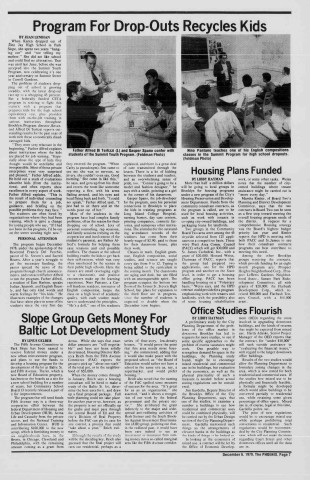
P r o g r a m F o r D r o p - O u t s R e c ' 'BY JEAN LENIHANWhen Karen dropped out of John Jay High School in Park Slope, she spent two years %u201changing out%u201d and %u201c not telling my mother.%u201d She did not like school and could find no alternative. That was until last June, before she was accepted into the Summit Youth Program, now celebrating it%u2019s one year anniversary on Summit Street in Carroll Gardens.The problem of students dropping out of school is growing steadily, with the latest drop-out rate up to a whopping 45 percent. But a federally funded CETA program is striving to fight this statistic with a program (hat prepares kids for the high school equivalency lest, plus provides them with on-the-job training in various institutions throughout Brooklyn. Program director, Reverend Alfred Di Terlizzi reports outstanding results for the past year of work with these economically disadvantaged kids.%u201cThey were very reluctant in the beginning,%u201d Father Alfred explains about institutions where the kids are placed for job training. %u201c Especially about the type of kids they thought would be unreliable and irresponsible. Most of these private enterprises were very surprised and pleased,%u201d Father Alfred adds. He held out a stack of evaluations aboutthe kids (from the institutions), and often reports show excellence in every aspeet of work. Father Alfred explains, %u201c This is the result of individual counseling to prepare them for a job, guidance, and briefing on the possible problems they may face.%u201d The students are often hired by organizations where they had been training, which is quite a change for young people who say, %u201c If I had not been in this program, I%u2019d be out on the street stealing right now.%u201dPERSONAL ATTENTIONThe program began December 1978, under the sponsorship of the Reverend Francis Del Vecchio, pastor of St. Steven%u2019s and Sacred Hearts. After a year%u2019s struggle to get the necessary funding, the pastor spread the news of the program through church announcements, and contacted Father Alfred to run the program. Father Alfred, a resident of East Harlem, speaks Italian, Spanish, and English fluently, and has only kind words and warm feelings for \illustrates examples of the changes that have taken place in some of his students since the very first dayFather Alfred Di Terlizzi (L) and Gasper Spano confer withstudents of the Summit Youth Program. (Feldman Photo)they entered the program. %u201c When Cathy (a pseudonym), first came to see me she was so nervous, so jittery, she couldn%u2019t even say, Good morning.%u2019 She came in like this,%u201d he says, and gets up from his chair and enters the room like someome reporting a fire, with his arms flailing around, and his eyes and head flying back and forth. %u201c I could not speak,%u201d Father Alfred said, %u201c I just had to sit there and let the words pour out of her.%u201dMost of the students in the program have had complex family problems, often the reason for their dropping out of school. Lots of personal counseling, rap sessions, and family sessions (relying on the cooperation and involvement of the students%u2019s parents), are Father Alfred%u2019s formula for helping them case tensions and end possible conflicts. The classes at the school building enable the kids to get back their self-esteem, which was very often smothered by the scenes in their public high schools. Here the classes are small (averaging eight to a classroom), and positive encounters make up the learning experience. Nino Pantano, a Carroll Gardens resident, instructor of English composition, keeps the class on a high level of academic quality, with each student made sure to understand the principles. %u201c He%u2019s a doll,%u201d one of his studentsexplained, and there is a great deal of care transmitted through the lesson. There is a lot of kidding between the students and teacher, and an overwhelming sense of pride, too. %u201c Connie%u2019s going to be a model and fashion designer,%u201d he says with a smile, pointing at a girl in the corner of his classroom.Gasper Spano, the job-developer for the program, uses his personal connections in Brooklyn to place the kids in training programs at Long Island College Hospital, nursing homes, day care centers, printing companies, cosmetic factories, and numerous other institutions. The stimulus for the outstar.d ing attendance records of the students has come from their hourly wage of $2.90, paid to them for their classroom hours, plus their work.Classes in math, English grammar, English composition, social studies, and science are taught every day from 9 to 12. Typing is being added to the curriculum in the coming month. The classrooms arc aging and dark, but are filled with an unconquerable spirit. The program occupies the bottom two floors of the former St. Steven High School, but plans for expansion to the third floor are in progress, since the number of students is expected to double when the December term begins.Slope Group Gets Money ForBaltic Lot Development StudyBY LINUS GELBERThe Fifth Avenue Committee in Park Slope has been named to revcive federal money under a new urban reinvestment program, and plans to use the funds to develop a housing program for the development of the lot at Baltic St. and Fifth Avenue. The lot, which is now Board of Education property, has been on the boards as a site for a new school building for a number of years, but Community School Board 13 recently released a part of it for improvements.The program that will send funds Fifth Avenue way is a three-way cooperative effort between the federal Department of Housing and Urban Development (HUD), Aetna Life and Casualty from the private sector, and the National Training and Information Center. HUD is contributing $100,000 to the new setup, which is furnishing money toAetna. While she says that exact dollar amounts are %u201c still negotiable%u201d and have not been solidly determined, Housing Director Rebecca Reich from the Fifth Avenue Committee (FAC) expects the group to pick up %u201c about one-sixth%u201d of the total pot, or in the neighborhood of $55,000.When the money comes through in January, Reich says a housing consultant will be hired to make a study of the Baltic St. lot, determine the best uses for it, and draw up a final proposal package. Full scale planning could not take place for another year or so, however, as the property is not yet officially up for grabs and must pass through the central Board of Ed and the city%u2019s Division of Real Property before the FAC can ply its case for site control, a process that could %u201c take about a year,%u201d Reich estimates.Nino Pantano teaches one of his English lclasses in the Summit Program for high school i .(Feldman Photo)Housing Plans FundedBY LIBBY HAYMANMore than half a million dollars will be going to local groups in Brooklyn for housing programs under a new program of the City%u2019s Housing Preservation and Development Department. Funds from the community consultant contracts, as the program is called, are to be used for local housing activities, such as work with tenants in co-oping city-owned buildings, and packaging loans for landlords.Two groups in the Community Board Two area were among the 45 citywide selected from 125 applicants on a competitive basis. These were Pratt Area Comm. Council (PACC) which will get $30,000 and St. James Cathedral, Inc., with a grant of $20,000. Howard Weiss, Chairman of PACC, reports that the group had prepared two applications, one for the HPD program and another on the State level, in order to get a housing office going. PACC has been handling housing on a %u201cVoluntary basis,%u201d Weiss says, and the HPD contract could provide for a program emphasizing work with tenants and landlords, with the possibility also of some housing rehabilitationwork, or some other tasks. Weiss notes that the number of cityowned buildings where tenant assistance might be carried out is %u201c more every day.%u201dMarsha Rimler, of Board Two%u2019s Planning and District Development Committee, says that the two contracts in Board Two can be seen as a first step toward meeting the overall housing program needs of the district. A request for a comprehensive Housing strategy was the Board%u2019s highest budget priority last year and Rimler reports that HPD is meeting with both PACC and St.James to see how their consultant contracts programs can best contribute to meeting this need.Among the other Brooklyn groups receiving the contracts, which provide funding for an eight month program arc: ProspectHeights Neighborhood Corp., Prospect Lefferts Gardens Neighborhood Assoc., Sunset Park Redevelopment Committee: all with grants of $20,000; the Flatbush Development Corp., which received $80,000 and Flatbush Tenants Council, with a $60,000 grant.Office Studies Flourish%u2014 : a u ^ . u , - i--- - A It U im i r*K %u25a0 -\\f *UrBronx, in Chicago, Cleveland and Philadelphia, with the remaining amount coming as a grant fromwill be the deciding key, Reich also guessed that the final project will turn out residential, perhaps as aseries of four-story, low-density houses. %u201c It would prove the point that this area needs more housing,%u201d she commented, adding that it would also make peace with the proposed school, as %u201c the Board of Education would rather not have a school in the same site as, say, a supermarket, and would prefer housing.%u201dReich also noted that the naming of the FAC spelled some measure of success for the area. %u201c It%u2019s great for us as an organization,%u201d she asserted, %u201c and it shows a recognition of our work by the federal government and the private sector.%u201d She attributed the grant indirectly to the major and widespread anti-redlining activities of Herb Steiner and the South Brooklyn Against Investment Discrimination (AID) group, pointing out that, in the rcdlined past, it would have been rare indeed to see anIh YCS! m o n l n r i n c i i r i i n p p f i r m c i n k -ing money into a so-called marginal area like the Fifth Avenue corridor.BY LIBBY HAYMANA preliminary study by the City Planning Department of the problems of the office market in downtown Brooklyn has led to requests for more studies, to see if some specific approaches to the problem of excess vacancies might work. One possible way to strengthen demand for space in the buildings, the Planning study found, might be to encourage mixed residential and commercial use in the buildings, but evaluation of the economics, as well as the physical practicality of such a measure is needed before actual zoning regulations can be considered.Jim Gardella, Deputy Director of the Brooklyn Office of the City Planning Department, says that one of the studies, to examine a number a buildings to see how residential and commercial uses could be combined physically, will be carried out by the Urban Design section of the City Planning Department. Gardella mentioned such things as the arrangements of elevator banks in the buildings astVio L -inH o


