


Page 227 - Demo
P. 227
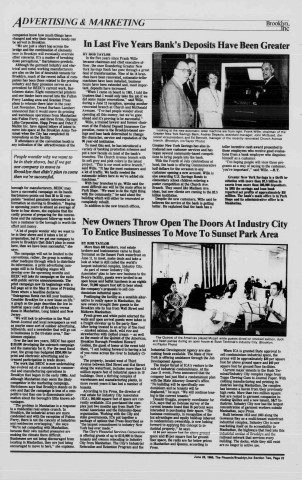
ADVERTISING & MARKETING Brooklyn, ____ inccompanies know how much things havechanged and why their business needs canbe served in Brooklyn.%u201cWe are just a short hop across thebridge and the combination of elementsiiere in Brooklyn wiii eventually overrideother concerns. It%u2019s a matter of breakingdown perceptions,%u201d Bartolomeo predicts.Although the garment industry and electrical and metal working manufacturersare also on the list of desirable tenants forBrooklyn, much of the recent influx of companies has been those related to the printingindustry and their presence serves as aprecedent for BEDC%u2019s current work, Bartolomeo states. Eight commercial printersand one binder have moved into the FultonFerry Landing area and Scanlan Pressplans to relocate there later in the year.Last November, Drexel Burham Lambertannounced that it would move its printingand warehouse operations from Manhattaninto Fulton Ferry, and three firms, OlympicLitho Corporation, Hopp Press and Peter F.Mallon Inc. have signed letters of intent tomove into space at the Brooklyn Army Terminal when the City has completed itsrenovations on the facility.If attendance at the convention booth isany indication of the attractiveness of thePeople wonder why we want tobe in their shows, but if we getone company to move toBrooklyn that didn *t plan to comethen we 're successfulborough for manufacturers, BEDC mayhave a successful campaign on its hands.Bartolomeo points out that 20 to 25 companies %u201cseemed genuinely interested in information on moving to Brooklyn.%u201d Hopingin upcoming years to attend an average ofthree to four shows, she explains that thecostly process of preparing for the conventions and the subsequent follow-up work tolure a customer to the borough is worth theeffort and money.%u201cA lot of people wonder why we want tobe in their shows and it takes a lot ofpreparation, but if we get one company tomove to Brooklyn that didn%u2019t plan to comehere, then we have been successful,%u201d shesays.The campaign will not be limited to theconventions, rather, the group is seekingother mediums through which to distributeits information. A print advertising campaign still in its fledgling stages willdevelop over the upcoming months andBEDC will take its campaign on the radiowith public service announcements. Theprint campaign saw its beginnings with afull page ad in the May 31 issue of PrintingNews where a headline declares:%u201cOutrageous Rents can kill your business.Consider Brooklyn for a new lease on life.%u201dA graph on the page describes the low industrial space costs of Brooklyn versusthose in Manhattan, Long Island and NewJersey.%u201cWe will look to advertise in the WallStreet Journal and local newspapers as wellas maybe some sort of outdoor advertising,billboards, and a newsletter that will go outto businesses in the tri-state area,%u201d Bartolomeo explains.Over the last two years, BEDC has spent$130,000 developing the outreach campaignand the materials for it. For the next fiscalyear, the group has budgeted $250,000 forprint and electronic advertising and increased participation in trade shows.The work that BEDC is now undertakinghas evolved out of a comeback in commercial and manufacturing operations inBrooklyn that began in the early 1980s. Andalthough Manhattan may seem the likelycompetitor in the marketing campaign,Bartolomeo says that Brooklyn stands on itsown and that the campaign is less of a competitive tool than one to disseminate information about the borough%u2019s little known advantages.%u201cThe problem in Manhattan is a responseto a residential real estate crunch. InBrooklyn, the industrial areas are morecondensed and with the exception of FultonFerry, there is not the concern of industriesand residencies overlapping,%u201d she says.%u201cWe%u2019re not competing with Manhattan,because their own market Dressures aremaking the climate there difficult.Businesses are not being discouraged fromlocating in Manhattan, they are just beingencouraged to move to here,%u201d she explains.In Last Five Years Bank%u2019s Deposits Have Been GreaterLooking at the new automatic teller m achine are from right: Frank Wille, chairman of theGreater New York Savings Bank; Audrey Depaola, assistant manager; John M cQuaid, divisional vice-president; and Ed Bennett, manager of the recently renovated Church Avenuebranch. (Brooklyn, inc/Taylor Photo)BY BOB i a YLiUKIn the five years since Frank Willebecame chairman and chief executive officer, the once floundering Greater NewYork Savings Bank has gone through a greatdeal of transformation. Nine of its 14 branches have been renovated, automatic-tellermachines have been installed, businesshours have been extended and, most important, deposits have increased.%u201cWhen I came on board in 1981,1 told thetnistees that I would only take the job if wedid some major renovations,%u201d said Wille,during a June 12 reception, opening anotherrenovated branch at Church and McDonaldAvenues. %u201cI%u2019ve had people wonder aboutspending all this money, but we%u2019ve goneahead and it%u2019s proving to be successful.%u201dWille, a trained lawyer and former chairman of the Federal Deposit Insurance Corporation, came to the Brooklyn-based savings and loan bank determined to changethe character, service and reputation of the90 year-old institution.To meet this end, he has introduced avariety of banking promotion schemes andput a new facade on most of the bank%u2019sbranches. The Church Avenue branch withits soft grey and pink colors is the latestproject. %u201cThis is our most active branch,%u201dsaid Wille. %u201cIt has the most customers anda lot of traffic. We badly needed theautomatic tellers here so we%u2019ve added sixmachines.%u201dWith four branches to go, Wille said themost difficult one will be the main office inPark Slope. %u201cWe want to do the right thingwith the community,%u201d he said about thebuilding which will either be renovated orcompletely rebuilt.In addition to the new branch offices,Greater New York Savings has also introduced new customer services and hasbegun several community-based competitions to bring people into the bank.With the Fourth of July celebrations athand, the bank is offering Commemorativehalf dollars for the occasion to anycustomer opening a new account. Wille isalso awarding U.S. Savings Bonds toelementary school children entering aposter competition at the Church Ave.Branch. They sound like Madison Ave.ideas, but new clients are coming to the $2.5billion institution.Despite the new customers, Wille said hebelieves the service at the bank is gettingbetter. He explained that the bank has ateller incentive cash award presented tothose employees who receive good evaluations from a bank employee who disguiseshimself as a customer.%u201cI%u2019m hoping people will view these programs as a way of saying to the customer,%u2018you%u2019re important%u2019,%u201d said Wille. %u2014R.T.Greater New York Savings is a thrift institution with more than $2.5 billion inassets from more than 300,000 depositors.In 1985 the savings and loan bankreported net profits of approximately $18million. The bank%u2019s main office is in ParkSlope and its administrative office is inManhattan.New Owners Throw Open The Doors At Industry CityTo Entice Businesses To Move To Sunset Park AreaBY ROB TAYLORMore than 400 bankers, real estatebrokers and businessmen came to BushTerminal on the Sunset Park waterfront onJune 11, to meet, make deals and take alook at what is still called the world%u2019slargest industrial complex, Industry City.As part of owner Industry CityAssociates%u2019 plan to lure new business to the35-acre facility, guests were invited to anopen house and buffet luncheon in an eighthfloor, 70,000 square foot loft to hear aboutthe company%u2019s proposals to sell condominium industrial space.Positioning the facility as a sensible alternative to costly space in Manhattan, thenew owners brought their guests to theBrooklyn site by bus from Wall Street andMidtown Manhattan.Fresh green and white paint adorned thewalls and upon arrival guests were taken ina freight elevator up to the party floor.After being treated to an array of fine food%u2014 smoked salmon, duck, wild rice andstrawberries with clotted cream %u2014 as wellas the music of the Quintet of the Americas,Brooklyn Borough President HowardGolden, the guest of honor at the event toldthem, %u201cI am looking forward to having a lotof you come across the river to Industry City.%u201dThe property, located west of ThirdAvenue between 32nd Street and 41st Streetalong the waterfront, includes more than 6.5million square feet of industrial space in 19buildings. Once a thriving complex ofwarehouses and manufacturing plants, inmore recent years it has lost a number oftenants.According to Ira Press, the director ofreal estate for Industry City Associates(ICA), 900,000 square feet of space are currently available. ICA purchased the complex just two months ago from Bush Terminal Associates and the Helmsley-Spearorganization. Working with the City andstate governments, ICA put together apackage of options that Press described as%u201cthe largest commitment to industry NewYork has ever made.%u201dThe City%u2019s Financial Services Cnmnratinn is offering grants of up to $110,000 to thosetenants and owners relocating to IndustryCity from Manhattan. The City%u2019s IndustrialRelocation and Retention Program and theThe Quintet of the Am ericas played Mozart while guests dined on smoked salmon, duckand fresh patries during an open house at Bush Terminal%u2019s Industry City (Brooklyninc/Taylor Photo)Industrial Development Agency are alsomaking funds available. The State of NewYork is offering assistance through the JobDevelopment Agency.Die major thrust of ICA%u2019s venture is thesale of industrial condominiums. At theJune 11 event, Press announced that thecompany had just filed a condominium planwith the State Attorney General%u2019s office.%u201cNo building will be specifically condominium and no tenants will bedisplaced,%u201d he says. %u201cWe will continue leasing to the current tenants.%u201dDonald Gioggia, property coordinator forICA, says that an inhouse survey of thecurrent tenants found that 25 percent wereinterested in purchasing their space. %u201cThebusiness community, in recognition of thetax advantages and equity build-up inherentin condominium ownership, is now lookingforward to applying this concept to industrial property,%u201d he says.At $4 npr Wlimra font t n r atynro ommulspace and $5 per square foot for groundfloor space, the rents are far below pricesin Manhattan and Queens, according toPress.When ICA is granted State approval tosell condominium industrial space, theprices will be approximately $30 per squarefoot for above ground space and $40 persquare foot for ground floor facilities.Current major tenants in the Bush Terminal/Industry City complex range fromTopps Chewing Gum to Journal Paper. Withclothing manufacturing and printing industries leaving Manhattan, the complexhas become a haven from their previouslyhigh rents. More than two million squarefeet are rented to garment companies including Quiltex and a new tenant, SAT Industries. Industry City now has toe largestconcentration of garment workers outsideManhattan, says Press.Built between 1913 and 1933 aiong theGowanus Bay as a multi-tenant waterfrontindustrial complex. Industry City is nowmarketing itself on its accessibility toManhattan, toe highways that feed into this%u2014 %u2014 %u2014A.: %u2014JC . L 1 . _ J il MM UVVMVII V* *-%u00bb* W O IJ 11 OUIVA UICrailroad network that services everybuilding. The docks, while they still existare no longer in active use.June 26,1966, The Phoenlx/Brooklyn.lnc Section Two, Page 23


