


Page 28 - Demo
P. 28
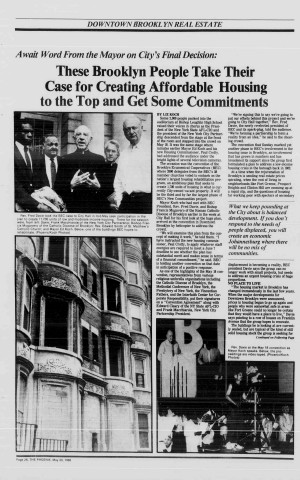
DOWNTOWNBROOKLYNREAL ESTA TEA wait Word From the Mayor on City%u2019s Final Decision:These Brooklyn People Take TheirCase for Creating Affordable Housingto the Top and Get Some CommitmentsRev. Fred Davie took the BEC case to City Hall in mid-May seek participation in theplan to create 11,700 units of low and m oderate incom e housing. There for the sessionwere, from left: Davie; Frank M acchiarola of the New York City Partnership; Bishop Francis M ugarvero of the C atholic Diocese of Brooklyn; Rev. Edward Sm ith of St. M atthew 'sC atholic Church; and Mayor Ed Koch. Below, one of the buildings BEC hopes torehabilitate. (Phoenix/Koch Photos)BY LIZ KOCHSome 2,000 people packed into the auditorium at Bishop Loughlin High School raised their voices in chorus as the President of the New York State AFL-CIO and the president of the New York City Partnership descended from the stage at the front of the room and stepped into the crowd on May 18. It was the same stage where minutes earlier Mayor Ed Koch and his new Housing Commissioner, Paul Crotty, had addressed the audience under the bright lights of several television cameras.The occasion was the convention of the Brooklyn Ecumenical Cooperatives (BEC) where 2000 delegates from the BEC%u2019s 38 member churches voted to embark on the nation%u2019s largest housing rehabilitation program, an ambitious plan that seeks to create 1,700 units of housing in what is currently City-owned vacant property. It will be the third and by far the largest phase of BEC%u2019s New Communities project.Mayor Koch who had met with BEC President, Rev. Fred Davie, and Bishop Francis Mugavero of the Roman Catholic Diocese of Brooklyn earlier in the week at City Hall for his first look at the huge plan, arrived at the convention in Downtown Brooklyn by helicopter to address the crowd.%u201cWe will examine this plan from the concept of making it work,%u201d he told them. %u201cI have instructed the new housing commissioner, Paul Crotty, to apply whatever staff energies are required to meet a June 7 deadline to see whether the plan has substantial merit and makes sense in terms of a financial commitment,%u201d he said. BEC is holding another convention on that date in anticipation of a positive response.As one of the highlights of the May 18 convention, representatives from various religious umbrella organizations including the Catholic Diocese of Brooklyn, the Methodist Conference of New York, the Presbytery of New York, the Vincentian Fathers, and the Interfaith Center for Corporate Responsibility, put their signatures on a %u201cConvention Agreement%u201d along with Edward Cleary of the NY State AFL-CIO and Frank Macchiarola, New York City Partnership President.%u201cWe%u2019re signing this to say we%u2019re going to put our efforts behind this project and we%u2019re going to City Hall together,%u201d Rev. Fred Davie, the newly re-elected president of BEC and its spark-plug, told the audience. %u201cWe%u2019re forming a partnership to form a reality from an idea,%u201d he said to the cheering crowd.The convention that Sunday marked yet another phase in BEC%u2019s involvement in the housing issue in Brooklyn, an involvement that has grown in numbers and has broadened its support since the group first formulated a plan to address a low-income housing crisis in the borough back in 1982.At a time when the rejuvenation of Brooklyn is sending real estate prices spiraling, when the cost of living in neighborhoods like Fort Greene, Prospect Heights and Clinton Hill are zooming up at a rapid clip, and the questions of housing for working poor with specters of secondaryWhat we keep pounding atthe City about is balanceddevelopment. If you don Vrespond to the needs ofpeople displaced, you willcreate an economicJohannesburg where therewill be no mix ofcommunities.displacement is becoming a reality, BEC president Davie says the group can no longer work with small projects, but needs to address an urgent housing crisis of huge proportions.NO PLACE TO LIVE%u201cThe housing market in Brooklyn has changed tremendously in the last few years. When the major developments for Downtown Brooklyn were announced, prices in housing began to go up again and people who were somewhat safe in areas like Fort Greene could no longer be certain that they would have a place to live,%u201d Davie says pointing to a row of houses on Franklin Avenue that the group hopes to renovate.The buildings he is looking at are currently sealed, but are typical of the kind of still solid housing stock the group is seeking forContinued on Following PageRev. Davie at the May 18 convention asM ayor Koch speaks. Below, the proceedings are video-taped. (Phoenix/KochPhotos)Page 26, THE P H O E N IX . M ay 29, 1986


