


Page 29 - Demo
P. 29
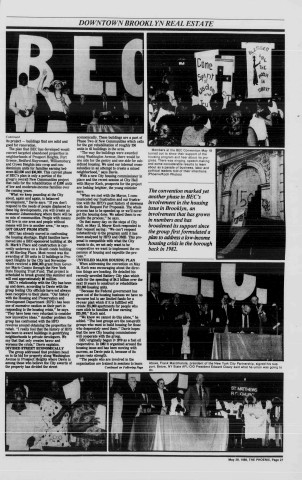
DOWNTOWN BROOKLYN REAL ESTATEContinuedits project %u2014 buildings that are solid and good for renovation.The plan that BEC has developed would convert targeted abandoned properties in neighborhoods of Prospect Heights, Fort Greene, Bedford Stuyvesant, Williamsburg and Crown Heights into co-op and condominium units for families earning between $12,000 and $30,000. This current phase of BEC%u2019s plan is only a portion of the group%u2019s overall New Communities project that calls for the rehabilitation of 8,800 units of low and moderate-income families over the coming years.%u201cWhat we keep pounding at the City about, again and again, is balanced development,%u201d Davie says. %u201cIf you don%u2019t respond to the needs of people displaced by these big developments, you will create an economic Johannesburg where there will be no mix of communities. People with means will live in one area and people without means wiii live in another area,%u201d he says. GOT GRANT FROM STATEBEC has already moved in confronting the housing shortage. Eight families have moved into a BEC-sponsored building at 104 St. Mark%u2019s Place and construction is currently underway on a 16-unit condo building at 149 Sterling Place. Most recent was the awarding of 110 units in 13 buildings in Prospect Heights by the City last November which received a $960,000 grant from Governor Mario Cuomo through the New York State Housing Trust Fund. That project is scheduled to break ground this summer and will cost approximately $6 million.BEC%u2019s relationship with the City has been up and down, according to Davie with the group feeling City officials have not always been receptive to their plans. %u201cOur history with the Housing and Preservation and Development Department (HPD) has been one of excessive caution on their part in responding to the housing crisis,%u201d he says. %u201cThey have been very reluctant to consider new innovative ideas.%u201d Another problem the group has confronted with the HPD revolves around obtaining the properties for rehab. %u201cI really feel that the history of HPD has been to award buildings in gentrifying neighborhoods to private developers. We say that that only creates havoc and worsens the crisis,%u201d Davie explains. DIVIDED STREET ECONOMICALLYThe group addressed that problem head on in its bid for property along Washington Avenue in Prospect Heights where Davie is among those who believe the City awards of the property has divided the streeteconomically. These buildings are a part of Phase Two of New Communities which calls for the gut rehabilitation of roughly 350 units in 45 buildings in the area.%u201cThe way the buildings were awarded along Washington Avenue, there would be one side for the gentry and one side for subsidized housing. We used our internal crosssubsidies in an attempt to create a mixed neighborhood,%u201d says Davie.With a new City housing commissioner in place and the recent session at City Hall with Mayor Koch, prospects for the project are looking brighter, the young minister says.%u201cWhen we met with the Mayor, I communicated our frustration and our frustration with the HPD%u2019s past history of slowness with the Request For Proposals. The whole process has to be speeded up or we%u2019ll never get the housing done. We asked them to expedite the process,%u201d he says.On that sunny day on the steps of City Haii, on May 13, Mayor Koch responded to that request saying: %u201cWe can%u2019t respond substantively to the program until it has been analysed by HPD and OMB. This proposal is compatible with what the City wants to do, we not only want to be cooperative we want to implement the expansion of housing and expedite the process.%u201dUNVEILED MAJOR HOUSING PLANWhen addressing the convention on May 18, Koch was encouraging about the direction things are heading. He detailed his recently unveiled Battery City plan which calls for the spending of $4.2 billion over the next 10 years to construct or rehabilitate 252,000 housing units.%u201cBecause the Federal government has gone out of the housing business we have no recourse but to use limited funds for a 10-year plan which if it is fulfilled will create 215,000 apartments for people who earn zilch to families of four earning $25,000,%u201d Koch said.%u201cWe know we cannot do this alone,%u201d he added. %u201cThe best groups are the non-profit groups who want to build housing for those who desperately need them.%u201d Davie hopes that the new City housing commissioner will cooperate with the group.BEC originally began in 1979 as a fuel oil cooperative. In 1982 it organized around the housing issue and has been moving with success, as Davie puts it, because of its grass roots strength.%u201cThe people who are involved in the organization are trained in sessions to learn Continued on Following PageM em bers at the BEC Convention May 18turned out to show their support of thehousing program and hear about its progress. There was singing, speech-m akingand some considerable results to learnabout as a parade of business, labor andpolitical leaders told of th eir intentions.(Phoenix/Koch Photos)The convention marked yetanother phase in BEC'sinvolvement in the housingissue in Brooklyn, aninvolvement that has grownin numbers and hasbroadened its support sincethe group first formulated aplan to address a low-incomehousing crisis in the boroughback in 1982.Above, Frank M acchiarola, president of the N ew York City Partnership, signed his support. Below, NY State A FL-C IO President Edward Cleary said what he union was going todo.May 29, 1986, THE PHOENIX, Page 27


