


Page 127 - Handout Digital Electronics
P. 127
state, since it is triggered by the clock connected to the Q  output of FF0. The same applies to FF2 and
            FF3. Initially all the flip flops are set to 1, that is FF0 = 1, FF1 = 0, FF2 = 0.
            The first flip flop (FF0) operates on a 1 o 0 clock transition (just like in the up counter) but FF1, FF2 and
            FF3 operate on a 0 to 1 clock transition since their clocks are connected to the  Q  outputs. Counting
            down always starts from the first flip flop (FF0). So, on a 1 to 0 transition FF0‟s present state (Q = 1) is
            toggled to a 0 and at the Q  output the 1 displaces the zero which is passed on to the clock and at FF1 the
            situation is J = K = 1, C = 0. This means FF1 does not change its state. The same applies to FF2 and
            FF3. (See example below)


                   FF3    FF2    FF1     FF0

                    1       1      1      1     Pre-set value (15)

                    1       1      1      0

                     .      .      .

                    0        0     0      1

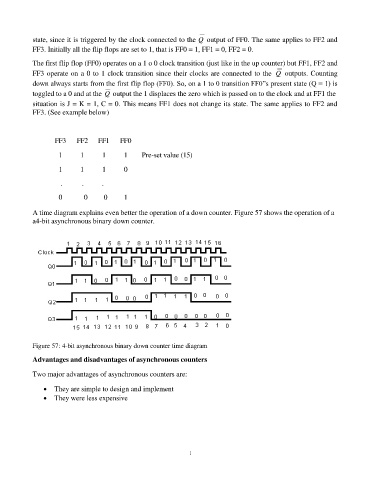
            A time diagram explains even better the operation of a down counter. Figure 57 shows the operation of a
            a4-bit asynchronous binary down counter.


            Figure 57: 4-bit asynchronous binary down counter time diagram

            Advantages and disadvantages of asynchronous counters

            Two major advantages of asynchronous counters are:

               •  They are simple to design and implement
               •  They were less expensive


                                                                127

