


Page 131 - Handout Digital Electronics
P. 131
The table below summarizes the operation of this synchronous counter.

               Q3  Q2     Q1     Q0      J      K      C
               0    0     0      1       1      1      1
               0    0     1      0       1      1      1
               0    0     1      1       1      1      1
               0    1     0      0       1      1      1
               .    .     .      .       1      1      1
               .    .     .      .       1      1      1
               1    1     1      .       1      1      1


            The time diagram  is  the same as  that of an asynchronous  up counter;  the only  difference is  that the
            propagation delays are not there.

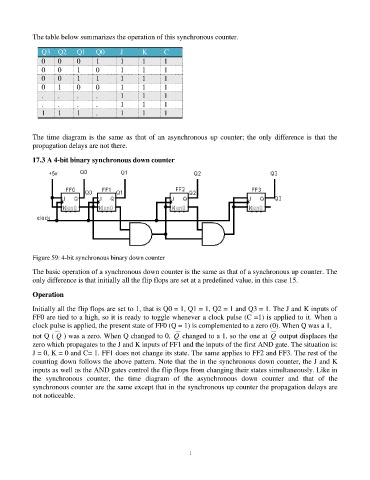
            17.3 A 4-bit binary synchronous down counter


            Figure 59: 4-bit synchronous binary down counter

            The basic operation of a synchronous down counter is the same as that of a synchronous up counter. The
            only difference is that initially all the flip flops are set at a predefined value, in this case 15.

            Operation

            Initially all the flip flops are set to 1, that is Q0 = 1, Q1 = 1, Q2 = 1 and Q3 = 1. The J and K inputs of
            FF0 are tied to a high, so it is ready to toggle whenever a clock pulse (C =1) is applied to it. When a
            clock pulse is applied, the present state of FF0 (Q = 1) is complemented to a zero (0). When Q was a 1,

            not Q ( Q ) was a zero. When Q changed to 0,  Q  changed to a 1, so the one at  Q  output displaces the
            zero which propagates to the J and K inputs of FF1 and the inputs of the first AND gate. The situation is:
            J = 0, K = 0 and C= 1. FF1 does not change its state. The same applies to FF2 and FF3. The rest of the
            counting down follows the above pattern. Note that the in the synchronous down counter, the J and K
            inputs as well as the AND gates control the flip flops from changing their states simultaneously. Like in
            the  synchronous  counter,  the  time  diagram  of  the  asynchronous  down  counter  and  that  of  the
            synchronous counter are the same except that in the synchronous up counter the propagation delays are
            not noticeable.


                                                                130

