


Page 129 - Handout Digital Electronics
P. 129
LECTURE 17 SYNCHRONOUS BINARY COUNTERS
            17.1 Introduction
            These were developed to eliminate the major problems associated with asynchronous binary counters
            namely:

               •  Slow speed of operation
               •  Erroneous counting at high frequencies when the number of bits involved is large.

            In synchronous counters, the external clock signal is connected to the clock input of every individual flip
            flop within the counter and in this way all flip flops are clocked together simultaneously at the same
            time. This gives a fixed time relationship. This means changes at the output occur in synchronization
            with the clock signal. The individual output bits change state at the same time in response to a common
            clock pulse. So, in synchronous counters there are no ripple effects and so no propagation delays.

            17.2 A 4-bit binary synchronous up counter


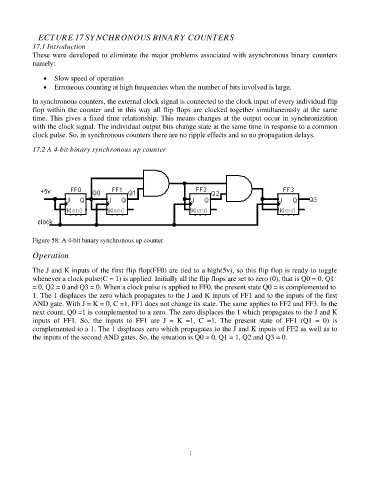
            Figure 58: A 4-bit binary synchronous up counter

            Operation

            The J and K inputs of the first flip flop(FF0) are tied to a high(5v), so this flip flop is ready to toggle
            whenever a clock pulse(C = 1) is applied. Initially all the flip flops are set to zero (0), that is Q0 = 0, Q1
            = 0, Q2 = 0 and Q3 = 0. When a clock pulse is applied to FF0, the present state Q0 = is complemented to
            1. The 1 displaces the zero which propagates to the J and K inputs of FF1 and to the inputs of the first
            AND gate. With J = K = 0, C =1, FF1 does not change its state. The same applies to FF2 and FF3. In the
            next count, Q0 =1 is complemented to a zero. The zero displaces the 1 which propagates to the J and K
            inputs  of  FF1.  So,  the  inputs  to  FF1  are  J  =  K  =1,  C  =1.  The  present  state  of  FF1  (Q1  =  0)  is
            complemented to a 1. The 1 displaces zero which propagates to the J and K inputs of FF2 as well as to
            the inputs of the second AND gates. So, the situation is Q0 = 0, Q1 = 1, Q2 and Q3 = 0.


                                                                129

