


Page 136 - Handout Digital Electronics
P. 136
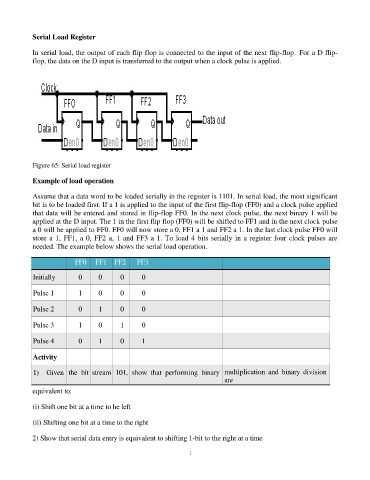
Serial Load Register

            In serial load, the output of each flip flop is connected to the input of the next flip-flop.  For a D flip-
            flop, the data on the D input is transferred to the output when a clock pulse is applied.


            Figure 65: Serial load register

            Example of load operation


            Assume that a data word to be loaded serially in the register is 1101. In serial load, the most significant
            bit is to be loaded first. If a 1 is applied to the input of the first flip-flop (FF0) and a clock pulse applied
            that data will be entered and stored in flip-flop FF0. In the next clock pulse, the next binary 1 will be
            applied at the D input. The 1 in the first flip flop (FF0) will be shifted to FF1 and in the next clock pulse
            a 0 will be applied to FF0. FF0 will now store a 0, FF1 a 1 and FF2 a 1. In the last clock pulse FF0 will
            store a 1, FF1, a 0, FF2 a, 1 and FF3 a 1. To load 4 bits serially in a register four clock pulses are
            needed. The example below shows the serial load operation.

                          FF0    FF1  FF2     FF3

            Initially      0      0      0      0


            Pulse 1        1      0      0      0

            Pulse 2        0      1      0      0


            Pulse 3        1      0      1      0

            Pulse 4        0      1      0      1

            Activity

            1)  Given  the  bit  stream  101,  show  that  performing  binary  multiplication  and  binary  division
                                                                           are
            equivalent to:

            (i) Shift one bit at a time to he left

            (ii) Shifting one bit at a time to the right


            2) Show that serial data entry is equivalent to shifting 1-bit to the right at a time

                                                                136

