


Page 21 - Handout Digital Electronics
P. 21
1.6 Hexadecimal Number System (Base16)
            The hexadecimal number system uses sixteen values to represent numbers. The values are 0 1 2 3 4 5 6
            7 8 9 A B C D E F with 0 having the least value and F having the greatest value. These numbers like octal
            numbers can also be used by machines and assembly language programmers to help with simply low-

            level programming. Four binary digits are equivalent to 1 hexadecimal digit. For example,  916   10012

            1.7 Converting decimal numbers to binary numbers

            There are a few ways to convert between decimal and binary. This book will consider three methods;
            the  remainder  theorem  also  called  the  division  method  and  the  Binary  Exponential  Placeholders
            method  for  the  whole  numbers  (integral  part)  and  the  multiplication  method  for  decimal  values
            (fractional part).


            Method 1: Using the remainder theorem

            Steps

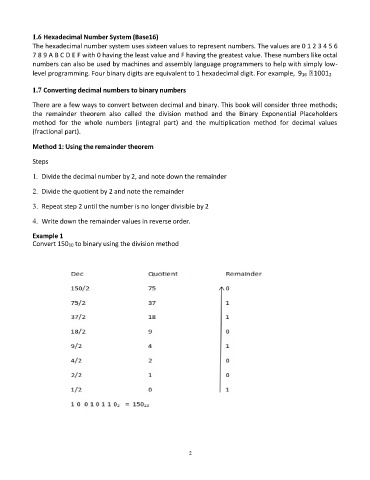
            1.  Divide the decimal number by 2, and note down the remainder

            2.  Divide the quotient by 2 and note the remainder

            3.  Repeat step 2 until the number is no longer divisible by 2

            4.  Write down the remainder values in reverse order.

            Example 1
            Convert 15010 to binary using the division method


                                                                21

