


Page 23 - Handout Digital Electronics
P. 23
Example 2:

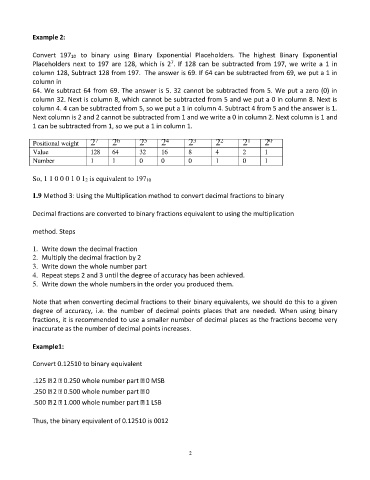
            Convert  19710  to  binary  using  Binary  Exponential  Placeholders.  The  highest  Binary  Exponential
                                                          7
            Placeholders  next  to  197  are  128,  which  is  2 .  If  128  can  be  subtracted  from  197,  we write  a  1  in
            column 128, Subtract 128 from 197.  The answer is 69. If 64 can be subtracted from 69, we put a 1 in
            column in
            64. We subtract 64 from 69. The answer is 5. 32 cannot be subtracted from 5. We put a zero (0) in
            column 32. Next is column 8, which cannot be subtracted from 5 and we put a 0 in column 8. Next is
            column 4. 4 can be subtracted from 5, so we put a 1 in column 4. Subtract 4 from 5 and the answer is 1.
            Next column is 2 and 2 cannot be subtracted from 1 and we write a 0 in column 2. Next column is 1 and
            1 can be subtracted from 1, so we put a 1 in column 1.

            Positional weight   2 7   2 6      2 5    2 4      2 3      2 2      2 1     2 0
            Value              128    64       32     16       8        4        2       1
            Number             1      1        0      0        0        1        0       1


            So, 1 1 0 0 0 1 0 12 is equivalent to 19710

            1.9 Method 3: Using the Multiplication method to convert decimal fractions to binary

            Decimal fractions are converted to binary fractions equivalent to using the multiplication


            method. Steps


            1.  Write down the decimal fraction
            2.  Multiply the decimal fraction by 2
            3.  Write down the whole number part
            4.  Repeat steps 2 and 3 until the degree of accuracy has been achieved.
            5.  Write down the whole numbers in the order you produced them.

            Note that when converting decimal fractions to their binary equivalents, we should do this to a given
            degree  of  accuracy,  i.e.  the  number  of  decimal  points  places  that  are  needed.  When  using  binary
            fractions, it is recommended to use a smaller number of decimal places as the fractions become very
            inaccurate as the number of decimal points increases.

            Example1:

            Convert 0.12510 to binary equivalent


            .125   2   0.250 whole number part   0 MSB
            .250   2   0.500 whole number part   0
            .500   2   1.000 whole number part   1 LSB


            Thus, the binary equivalent of 0.12510 is 0012


                                                                23

