


Page 28 - Handout Digital Electronics
P. 28
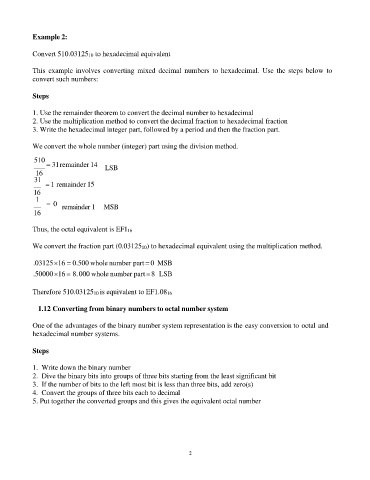
Example 2:
Convert 510.0312510 to hexadecimal equivalent
This example involves converting mixed decimal numbers to hexadecimal. Use the steps below to
convert such numbers:
Steps
1. Use the remainder theorem to convert the decimal number to hexadecimal
2. Use the multiplication method to convert the decimal fraction to hexadecimal fraction
3. Write the hexadecimal integer part, followed by a period and then the fraction part.
We convert the whole number (integer) part using the division method.
510
= 31 remainder 14 LSB
16
31
= 1 remainder 15
16
1
= 0 remainder 1 MSB
16
Thus, the octal equivalent is EF116
We convert the fraction part (0.0312510) to hexadecimal equivalent using the multiplication method.
.03125 16 = 0.500 whole number part = 0 MSB
.50000 16 = 8. 000 whole number part = 8 LSB
Therefore 510.0312510 is equivalent to EF1.0816
1.12 Converting from binary numbers to octal number system
One of the advantages of the binary number system representation is the easy conversion to octal and
hexadecimal number systems.
Steps
1. Write down the binary number
2. Dive the binary bits into groups of three bits starting from the least significant bit
3. If the number of bits to the left most bit is less than three bits, add zero(s)
4. Convert the groups of three bits each to decimal
5. Put together the converted groups and this gives the equivalent octal number
28

