


Page 33 - Handout Digital Electronics
P. 33
4.2 Laws of Boolean algebra

            The basic laws/properties of Boolean algebra are:

               •  Commutative
               •  Distributive
               •  Identity
               •  Complement
               •  Associative

            The commutative property states that: The order that two Boolean variables appear in an AND or function
            is not significant, for example (AB = BA), (A+B) = (B+A).

            The distributive property shows how a Boolean variable is distributed over an expression with which it is
            ANDed, for example A (B+C) = AB+AC or A+BC= (A+B) (A+C).

            The identity property states that a variable that is Ande or is ORed with itself produces the original
            variable, for example A.A = A or A + A = A = A.

            The  complement  is  derived  from  the  involution  theorem  which  states  that  the  complement  of  a
            complement leaves the original variable unchanged.

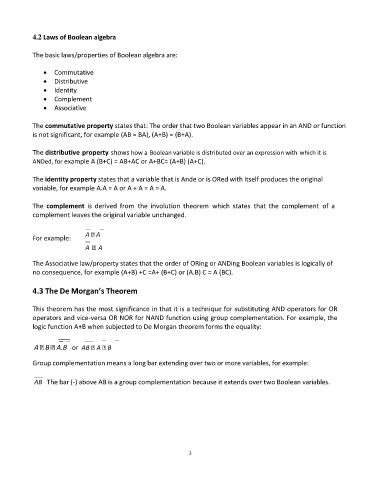
                             A   A
            For example:
                             A   A


            The Associative law/property states that the order of ORing or ANDing Boolean variables is logically of
            no consequence, for example (A+B) +C =A+ (B+C) or (A.B) C = A (BC).

            4.3 The De Morgan’s Theorem


            This theorem has the most significance in that it is a technique for substituting AND operators for OR
            operators and vice-versa OR NOR for NAND function using group complementation. For example, the
            logic function A+B when subjected to De Morgan theorem forms the equality:


            A   B   A.B  or  AB   A   B

            Group complementation means a long bar extending over two or more variables, for example:

            AB   The bar (-) above AB is a group complementation because it extends over two Boolean variables.


                                                                33

