


Page 38 - Handout Digital Electronics
P. 38
LECTURE 5 TRUTH TABLES


            5.1 Introduction

            A truth table, in Boolean algebra is a  table used to calculate the functional value of a Boolean function
            or expression on each of the Boolean variables. The truth tables are used to show or tell whether a
            Boolean function returns a 1 (true) or a 0 (false) for all the valid input values. Truth tables are popular
            with logic gates, combinational and sequential circuits. This is because it does not matter how complex
            a Boolean function is, the final output value computes to a 1(true) or 0 (false) value. A truth table is
            made up of columns for each input variable, for example (for example, A, and B) and one final (output)
            column  for  all  the  possible  outputs  (results)  of  the  logical  operation  the  truth  table  is  meant  to
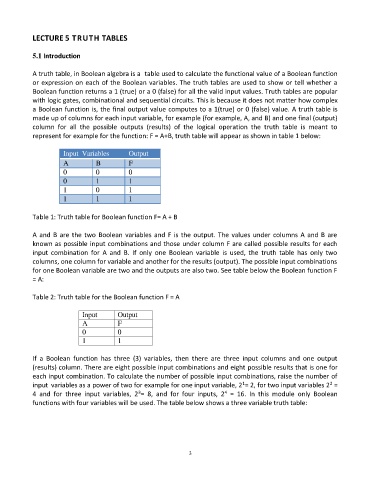
            represent for example for the function: F = A+B, truth table will appear as shown in table 1 below:

                      Input  Variables      Output
                      A          B          F
                      0          0          0
                      0          1          1
                      1          0          1
                      1          1          1

            Table 1: Truth table for Boolean function F= A + B

            A and B are the two Boolean variables and F is the output. The values under columns A and B are
            known as possible input combinations and those under column F are called possible results for each
            input  combination  for  A  and  B.  If  only  one  Boolean  variable  is  used,  the  truth  table  has  only  two
            columns, one column for variable and another for the results (output). The possible input combinations
            for one Boolean variable are two and the outputs are also two. See table below the Boolean function F
            = A:

            Table 2: Truth table for the Boolean function F = A

                            Input       Output
                            A           F
                            0           0
                            1           1


            If  a  Boolean  function  has  three  (3)  variables,  then  there  are  three  input  columns  and  one  output
            (results) column. There are eight possible input combinations and eight possible results that is one for
            each input combination. To calculate the number of possible input combinations, raise the number of
                                                                                 1
                                                                                                              2
            input  variables as a power of two for example for one input variable, 2 = 2, for two input variables 2  =
                                               3
                                                                           4
            4  and  for  three  input  variables,  2 =  8,  and  for  four  inputs,  2   =  16.  In  this  module  only  Boolean
            functions with four variables will be used. The table below shows a three variable truth table:


                                                                38

