


Page 41 - Handout Digital Electronics
P. 41
Worked example 1
Given the Boolean function below expressed in the sum of products (SOP), convert it to the product of
sum (POS) form: F( A, B, C) = (1,2,4,7) What the Boolean expression/function means is that at the
input combinations in parenthesis, the output F =1. So, to convert this function into POS, use input
combinations where F = 0. From the above expression F = 0 in the following input combinations, that is
that input combinations absent in the function, 000, 011, 101, 110. This can now be written as: F
(A, B, C) = ABC + ABC + ABC + ABC . Change this negative function to a positive one using the
complement law, for example: F ( A, B, C) = F( A, B, C) = ABC + ABC + ABC + ABC The principle
that what you do to the left, do it also to the right. That is why there is that long negation/complement
bar over the expression. This can then be written as: F(A, B, C) = (ABC ) + ( ABC ) + ( ABC) + (ABC )
This can then be written as F = (A + B + C) • (A + B + C ) • (A + B + C) • (A + B + C) . This is POS
form.
The sum of products (SOP) and the product of sums (POS) represent the same Boolean function. This
can be shown by using the input combination values in the truth table and the values of the output
column F which remain the same. Sometimes it is also necessary to draw the logic circuit of the POS
and simulate or trace the input values and the output values.
Given the Boolean function F( A, B, C) = (1,2,3.5,6) :
(i) Produce the product of sum (POS) form
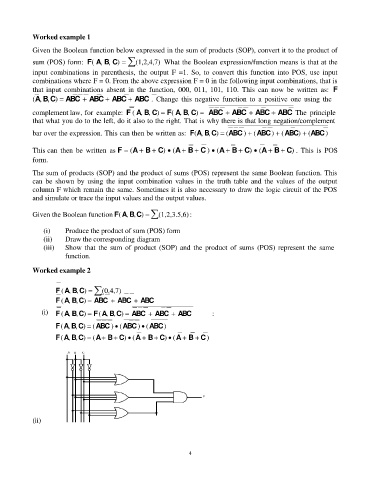
(ii) Draw the corresponding diagram
(iii) Show that the sum of product (SOP) and the product of sums (POS) represent the same
function.
Worked example 2
F ( A, B, C) = (0,4,7)
F ( A, B, C) = ABC + ABC + ABC
(i) F ( A, B, C) = F ( A, B, C) = ABC + ABC + ABC :
F ( A, B, C) = ( ABC ) • ( ABC ) • ( ABC )
F ( A, B, C) = ( A + B + C) • ( A + B + C) • ( A + B + C )
(ii)
41

