


Page 39 - Handout Digital Electronics
P. 39
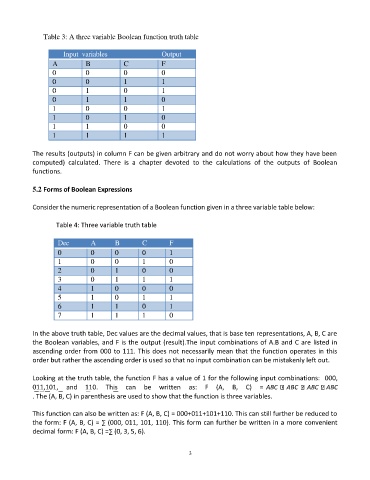
Table 3: A three variable Boolean function truth table

                      Input  variables                 Output
                  A          B            C            F
                  0          0            0            0
                  0          0            1            1
                  0          1            0            1
                  0          1            1            0
                  1          0            0            1
                  1          0            1            0
                  1          1            0            0
                  1          1            1            1

            The results (outputs) in column F can be given arbitrary and do not worry about how they have been
            computed)  calculated.  There  is  a  chapter  devoted  to  the  calculations  of  the  outputs  of  Boolean
            functions.

            5.2 Forms of Boolean Expressions

            Consider the numeric representation of a Boolean function given in a three variable table below:


                    Table 4: Three variable truth table

                    Dec        A       B        C        F
                    0          0       0        0        1
                    1          0       0        1        0
                    2          0       1        0        0
                    3          0       1        1        1
                    4          1       0        0        0
                    5          1       0        1        1
                    6          1       1        0        1
                    7          1       1        1        0

            In the above truth table, Dec values are the decimal values, that is base ten representations, A, B, C are
            the Boolean variables, and F is the output (result).The input combinations of A.B and C are listed in
            ascending order from 000 to 111. This does not necessarily mean that the function operates in this
            order but rather the ascending order is used so that no input combination can be mistakenly left out.

            Looking at the truth table, the function F has a value of 1 for the following input combinations:  000,
            011,101,   and   110.   This   can   be   written  as:   F   (A,  B,  C)   =  ABC    ABC    ABC   ABC
            . The (A, B, C) in parenthesis are used to show that the function is three variables.


            This function can also be written as: F (A, B, C) = 000+011+101+110. This can still further be reduced to
            the form: F (A, B, C) = ∑ (000, 011, 101, 110). This form can further be written in a more convenient
            decimal form: F (A, B, C) =∑ (0, 3, 5, 6).


                                                                39

