


Page 27 - Handout Digital Electronics
P. 27
Method 1: Using the remainder theorem
Steps
1. Divide the decimal number by 16 and note down the remainder
2. Divide what's left by 16 and note the remainder
3. Repeat step 2 until the number is no longer divisible by 16
4. Write down the remainder values in reverse order.
Example
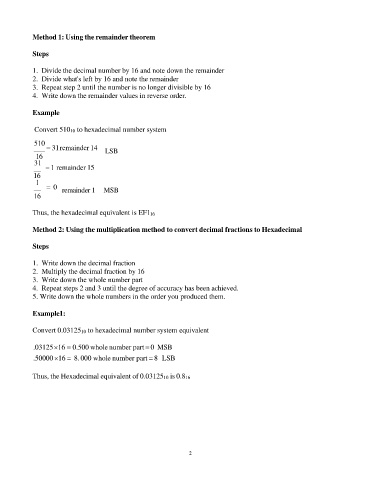
Convert 51010 to hexadecimal number system
510
= 31 remainder 14 LSB
16
31
= 1 remainder 15
16
1
= 0 remainder 1 MSB
16
Thus, the hexadecimal equivalent is EF116
Method 2: Using the multiplication method to convert decimal fractions to Hexadecimal
Steps
1. Write down the decimal fraction
2. Multiply the decimal fraction by 16
3. Write down the whole number part
4. Repeat steps 2 and 3 until the degree of accuracy has been achieved.
5. Write down the whole numbers in the order you produced them.
Example1:
Convert 0.0312510 to hexadecimal number system equivalent
.03125 16 = 0.500 whole number part = 0 MSB
.50000 16 = 8. 000 whole number part = 8 LSB
Thus, the Hexadecimal equivalent of 0.0312510 is 0.816
27

