


Page 24 - Handout Digital Electronics
P. 24
Example 2:
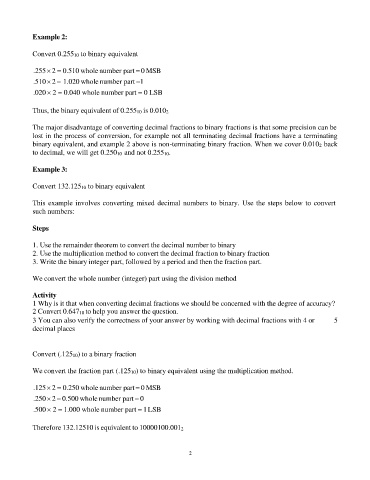
Convert 0.25510 to binary equivalent
.255 2 = 0.510 whole number part = 0 MSB
.510 2 = 1.020 whole number part =1
.020 2 = 0.040 whole number part = 0 LSB
Thus, the binary equivalent of 0.25510 is 0.0102
The major disadvantage of converting decimal fractions to binary fractions is that some precision can be
lost in the process of conversion, for example not all terminating decimal fractions have a terminating
binary equivalent, and example 2 above is non-terminating binary fraction. When we cover 0.0102 back
to decimal, we will get 0.25010 and not 0.25510.
Example 3:
Convert 132.12510 to binary equivalent
This example involves converting mixed decimal numbers to binary. Use the steps below to convert
such numbers:
Steps
1. Use the remainder theorem to convert the decimal number to binary
2. Use the multiplication method to convert the decimal fraction to binary fraction
3. Write the binary integer part, followed by a period and then the fraction part.
We convert the whole number (integer) part using the division method
Activity
1 Why is it that when converting decimal fractions we should be concerned with the degree of accuracy?
2 Convert 0.64710 to help you answer the question.
3 You can also verify the correctness of your answer by working with decimal fractions with 4 or 5
decimal places
Convert (.12510) to a binary fraction
We convert the fraction part (.12510) to binary equivalent using the multiplication method.
.125 2 = 0.250 whole number part = 0 MSB
.250 2 = 0.500 whole number part = 0
.500 2 = 1.000 whole number part = 1 LSB
Therefore 132.12510 is equivalent to 10000100.0012
24

