


Page 56 - Handout Digital Electronics
P. 56
7.5 Examples of minimizing 2-Boolean variables functions


            Example 1

            Consider the Boolean function: F (A, B) = ∑ (2, 3) =  AB + AB
            This function means that at the input combination 10(2) and (11) 3, the value of F = 1. A truth table of
            same function is shown below:

                          A     B     F
                          0     0     0
                          0     1     0
                          1     0     1
                          1     1     1
            There are simple steps to be followed when using K maps to minimize Boolean functions:

            1. Draw the 2-variables K map

            2. Fill out the values of F in the corresponding squares (where F = 1 only)

                                                                n
            3. Put the binary 1s in groups of 2s, 4s, 8s in general 2  where n = 1, 2, 3 etc.
            For a 2-variable K map the maximum number of 1s in a group is 2, for a 3-variable K map the maximum
            is 4 and for a 4-varible K map the maximum number of 1s in a group is 8.

            4. Discard the variable that  has  changed its value  (toggled) and the one that  has  not  changed is  the
            answer or part of the answer. If there are more than one group, the variables that have not toggled are
            combined by the OR (+) sign. These steps apply to all K maps.

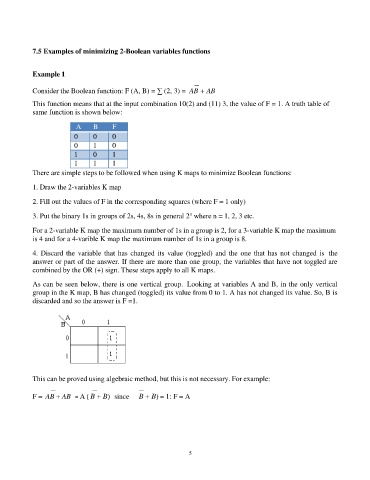
            As can be seen below, there is one vertical group.  Looking at variables A and B, in the only vertical
            group in the K map, B has changed (toggled) its value from 0 to 1. A has not changed its value. So, B is
            discarded and so the answer is F =1.


            This can be proved using algebraic method, but this is not necessary. For example:


            F =  AB + AB  = A ( B + B)  since   B + B) = 1: F = A


                                                                56

