


Page 57 - Handout Digital Electronics
P. 57
Example 2

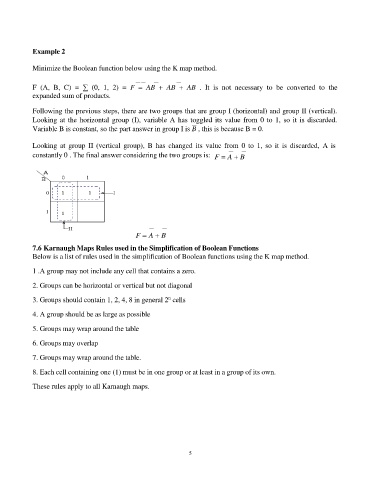
            Minimize the Boolean function below using the K map method.

            F  (A,  B,  C)  =  ∑  (0,  1,  2)  =  F  =  AB  +  AB  +  AB  .  It  is  not  necessary  to  be  converted  to  the
            expanded sum of products.

            Following the previous steps, there are two groups that are group I (horizontal) and group II (vertical).
            Looking at the horizontal group (I), variable A has toggled its value from 0 to 1, so it is discarded.
            Variable B is constant, so the part answer in group I is B , this is because B = 0.

            Looking  at  group  II (vertical  group),  B  has  changed  its  value  from  0  to  1,  so  it  is  discarded,  A  is

            constantly 0 . The final answer considering the two groups is:   F = A + B


                                              F = A + B
            7.6 Karnaugh Maps Rules used in the Simplification of Boolean Functions
            Below is a list of rules used in the simplification of Boolean functions using the K map method.

            1 .A group may not include any cell that contains a zero.

            2. Groups can be horizontal or vertical but not diagonal

                                                         n
            3. Groups should contain 1, 2, 4, 8 in general 2  cells
            4. A group should be as large as possible

            5. Groups may wrap around the table

            6. Groups may overlap

            7. Groups may wrap around the table.

            8. Each cell containing one (1) must be in one group or at least in a group of its own.

            These rules apply to all Karnaugh maps.


                                                                57

