


Page 61 - Handout Digital Electronics
P. 61
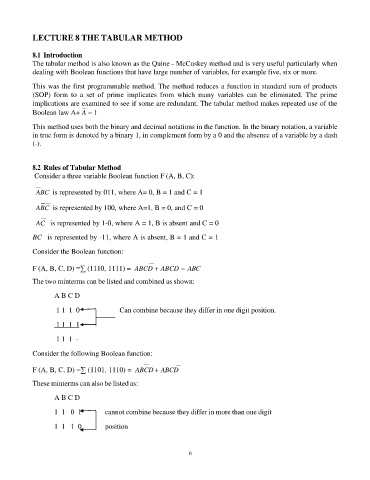
LECTURE 8 THE TABULAR METHOD

            8.1 Introduction
            The tabular method is also known as the Quine - McCuskey method and is very useful particularly when
            dealing with Boolean functions that have large number of variables, for example five, six or more.

            This was the first programmable method. The method reduces a function in standard sum of products
            (SOP)  form  to  a  set  of  prime  implicates  from  which  many  variables  can  be  eliminated.  The  prime
            implications are examined to see if some are redundant. The tabular method makes repeated use of the
            Boolean law A+ A = 1

            This method uses both the binary and decimal notations in the function. In the binary notation, a variable
            in true form is denoted by a binary 1, in complement form by a 0 and the absence of a variable by a dash
            (-).


            8.2 Rules of Tabular Method
            Consider a three variable Boolean function F (A, B, C):

             ABC  is represented by 011, where A= 0, B = 1 and C = 1

             ABC  is represented by 100, where A=1, B = 0, and C = 0

             AC  is represented by 1-0, where A = 1, B is absent and C = 0

            BC  is represented by -11, where A is absent, B = 1 and C = 1

            Consider the Boolean function:


            F (A, B, C, D) =∑ (1110, 1111) =  ABCD + ABCD = ABC
            The two minterms can be listed and combined as shown:

                   A B C D

                    1 1  1  0            Can combine because they differ in one digit position.

                    1 1  1  1

                    1 1  1  -

            Consider the following Boolean function:

            F (A, B, C, D) =∑ (1101, 1110) =  ABCD + ABCD
            These minterms can also be listed as:

                   A B C D

                   1  1  0  1       cannot combine because they differ in more than one digit

                   1  1  1  0       position


                                                                61

