


Page 43 - Elevating Excellence: Raising the Bar in Ease of Doing Business
P. 43
BE R.I.C.H.E.R. SELF-ASSESSMENT TOOLKIT FOR BUSINESS

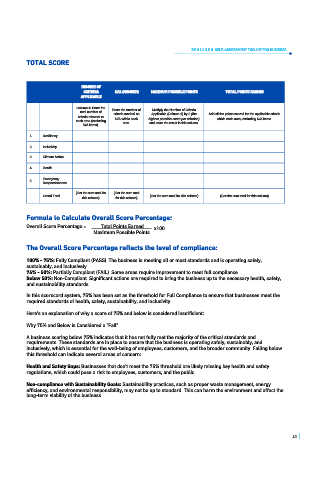
           TOTAL SCORE


                              NUMBER OF
                               CRITERIA    N/A (NUMBER)  MAXIMUM POSSIBLE POINTS   TOTAL POINTS EARNED
                              APPLICABLE
                             Column 1: Enter the  Enter the number of  Multiply the Number of Criteria
                              total number of
                             criteria relevant to  criteria marked as  Applicable (Column 1) by 2 (the  Add all the points scored for the applicable criteria
                            each area (excluding  N/A within each  highest possible score per criterion)  within each area, excluding N/A items.
                               N/A items).    area.    and enter the result in this column.
            1   Resiliency

            2   Inclusivity
            3   Climate Action

            4   Health
                Emergency
            5
                Responsiveness
                            (Get the sum total for  (Get the sum total
                Grand Total                            (Get the sum total for this column)  (Get the sum total for this column)
                               this column)  for this column)

           Formula to Calculate Overall Score Percentage:
           Overall Score Percentage =            Total Points Earned  x100
                                                                  Maximum Possible Points


           The Overall Score Percentage reflects the level of compliance:
           100% - 75%: Fully Compliant (PASS). The business is meeting all or most standards and is operating safely,
           sustainably, and inclusively.
           74% - 50%: Partially Compliant (FAIL). Some areas require improvement to meet full compliance.
           Below 50%: Non-Compliant. Significant actions are required to bring the business up to the necessary health, safety,
           and sustainability standards.

           In this scorecard system, 75% has been set as the threshold for Full Compliance to ensure that businesses meet the
           required standards of health, safety, sustainability, and inclusivity.

           Here's an explanation of why a score of 75% and below is considered insufficient:
           Why 75% and Below is Considered a "Fail"

           A business scoring below 75% indicates that it has not fully met the majority of the critical standards and
           requirements. These standards are in place to ensure that the business is operating safely, sustainably, and
           inclusively, which is essential for the well-being of employees, customers, and the broader community. Falling below
           this threshold can indicate several areas of concern:

           Health and Safety Gaps: Businesses that don't meet the 75% threshold are likely missing key health and safety
           regulations, which could pose a risk to employees, customers, and the public.

           Non-compliance with Sustainability Goals: Sustainability practices, such as proper waste management, energy
           efficiency, and environmental responsibility, may not be up to standard. This can harm the environment and affect the
           long-term viability of the business.


                                                                                                           40

