


Page 16 - Pharmaceutics III_ 02-06-01304_Fall 2025_ Pharm D_Electronic book
P. 16
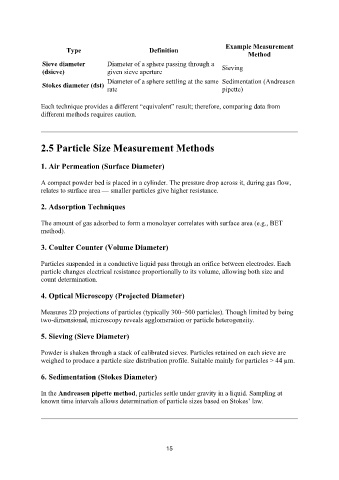
Type                   Definition                                 Example Measurement
                                                                           Method

Sieve diameter         Diameter of a sphere passing through a     Sieving
(dsieve)               given sieve aperture

Stokes diameter (dst)  Diameter of a sphere settling at the same  Sedimentation (Andreasen
                       rate                                       pipette)

Each technique provides a different “equivalent” result; therefore, comparing data from
different methods requires caution.

2.5 Particle Size Measurement Methods

1. Air Permeation (Surface Diameter)

A compact powder bed is placed in a cylinder. The pressure drop across it, during gas flow,
relates to surface area — smaller particles give higher resistance.

2. Adsorption Techniques

The amount of gas adsorbed to form a monolayer correlates with surface area (e.g., BET
method).

3. Coulter Counter (Volume Diameter)

Particles suspended in a conductive liquid pass through an orifice between electrodes. Each
particle changes electrical resistance proportionally to its volume, allowing both size and
count determination.

4. Optical Microscopy (Projected Diameter)

Measures 2D projections of particles (typically 300–500 particles). Though limited by being
two-dimensional, microscopy reveals agglomeration or particle heterogeneity.

5. Sieving (Sieve Diameter)

Powder is shaken through a stack of calibrated sieves. Particles retained on each sieve are
weighed to produce a particle size distribution profile. Suitable mainly for particles > 44 µm.

6. Sedimentation (Stokes Diameter)

In the Andreasen pipette method, particles settle under gravity in a liquid. Sampling at
known time intervals allows determination of particle sizes based on Stokes’ law.

                       15

