


Page 11 - Pharmaceutics III_ 02-06-01304_Fall 2025_ Pharm D_Electronic book
P. 11
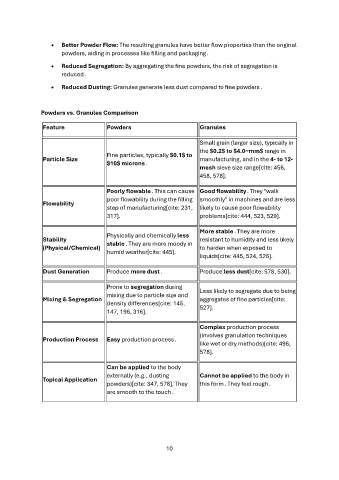
• Better Powder Flow: The resulting granules have better flow properties than the original
    powders, aiding in processes like filling and packaging .

• Reduced Segregation: By aggregating the fine powders, the risk of segregation is
    reduced .

• Reduced Dusting: Granules generate less dust compared to fine powders .

Powders vs. Granules Comparison

Feature               Powders                             Granules

Particle Size         Fine particles, typically $0.1$ to  Small grain (larger size), typically in
                      $10$ microns .                      the $0.2$ to $4.0~mm$ range in
                                                          manufacturing, and in the 4- to 12-
                                                          mesh sieve size range[cite: 456,
                                                          458, 578].

                      Poorly flowable . This can cause Good flowability . They "walk

Flowability           poor flowability during the filling smoothly" in machines and are less

                      step of manufacturing[cite: 231, likely to cause poor flowability

                      317].                               problems[cite: 444, 523, 529].

Stability             Physically and chemically less      More stable . They are more
(Physical/Chemical)   stable . They are more moody in     resistant to humidity and less likely
                      humid weather[cite: 445].           to harden when exposed to
                                                          liquids[cite: 445, 524, 526].

Dust Generation       Produce more dust .                 Produce less dust[cite: 578, 530].

                      Prone to segregation during         Less likely to segregate due to being
                                                          aggregates of fine particles[cite:
Mixing & Segregation  mixing due to particle size and     527].
                      density differences[cite: 145,

                      147, 196, 316].

Production Process Easy production process .              Complex production process
                                                          (involves granulation techniques
                                                          like wet or dry methods)[cite: 496,
                                                          578].

Topical Application   Can be applied to the body          Cannot be applied to the body in
                      externally (e.g., dusting           this form . They feel rough .
                      powders)[cite: 347, 578]. They
                      are smooth to the touch .

                                           10

