


Page 7 - Pharmaceutics III_ 02-06-01304_Fall 2025_ Pharm D_Electronic book
P. 7
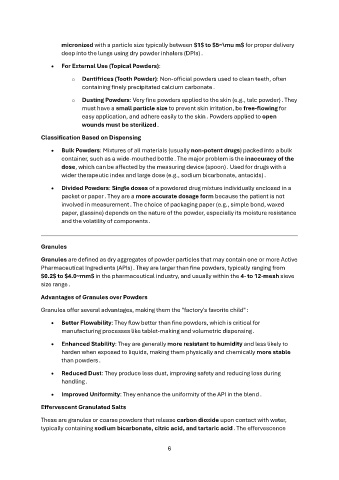
micronized with a particle size typically between $1$ to $5~\mu m$ for proper delivery
         deep into the lungs using dry powder inhalers (DPIs) .

    • For External Use (Topical Powders):

              o Dentifrices (Tooth Powder): Non-official powders used to clean teeth, often
                   containing finely precipitated calcium carbonate .

              o Dusting Powders: Very fine powders applied to the skin (e.g., talc powder) . They
                   must have a small particle size to prevent skin irritation, be free-flowing for
                   easy application, and adhere easily to the skin . Powders applied to open
                   wounds must be sterilized .

Classification Based on Dispensing

    • Bulk Powders: Mixtures of all materials (usually non-potent drugs) packed into a bulk
         container, such as a wide-mouthed bottle . The major problem is the inaccuracy of the
         dose, which can be affected by the measuring device (spoon) . Used for drugs with a
         wider therapeutic index and large dose (e.g., sodium bicarbonate, antacids) .

    • Divided Powders: Single doses of a powdered drug mixture individually enclosed in a
         packet or paper . They are a more accurate dosage form because the patient is not
         involved in measurement . The choice of packaging paper (e.g., simple bond, waxed
         paper, glassine) depends on the nature of the powder, especially its moisture resistance
         and the volatility of components .

Granules

Granules are defined as dry aggregates of powder particles that may contain one or more Active
Pharmaceutical Ingredients (APIs) . They are larger than fine powders, typically ranging from
$0.2$ to $4.0~mm$ in the pharmaceutical industry, and usually within the 4- to 12-mesh sieve
size range .

Advantages of Granules over Powders

Granules offer several advantages, making them the "factory's favorite child" :

    • Better Flowability: They flow better than fine powders, which is critical for
         manufacturing processes like tablet-making and volumetric dispensing .

    • Enhanced Stability: They are generally more resistant to humidity and less likely to
         harden when exposed to liquids, making them physically and chemically more stable
         than powders .

    • Reduced Dust: They produce less dust, improving safety and reducing loss during
         handling .

    • Improved Uniformity: They enhance the uniformity of the API in the blend .

Effervescent Granulated Salts

These are granules or coarse powders that release carbon dioxide upon contact with water,
typically containing sodium bicarbonate, citric acid, and tartaric acid . The effervescence

                                                             6

