


Page 6 - Pharmaceutics III_ 02-06-01304_Fall 2025_ Pharm D_Electronic book
P. 6
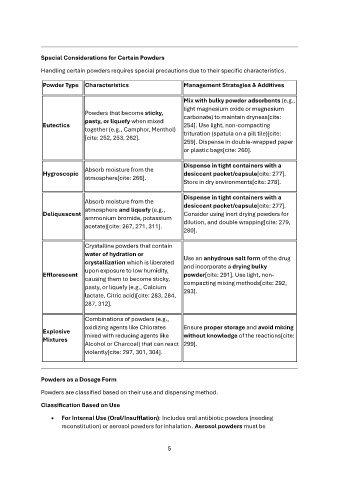
Special Considerations for Certain Powders
Handling certain powders requires special precautions due to their specific characteristics .

Powder Type Characteristics                          Management Strategies & Additives

Eutectics     Powders that become sticky,            Mix with bulky powder adsorbents (e.g.,
              pasty, or liquefy when mixed           light magnesium oxide or magnesium
              together (e.g., Camphor, Menthol)      carbonate) to maintain dryness[cite:
              [cite: 252, 253, 262].                 254]. Use light, non-compacting
                                                     trituration (spatula on a pill tile)[cite:
                                                     259]. Dispense in double-wrapped paper
                                                     or plastic bags[cite: 260].

Hygroscopic   Absorb moisture from the               Dispense in tight containers with a
              atmosphere[cite: 266].                 desiccant packet/capsule[cite: 277].
                                                     Store in dry environments[cite: 278].

              Absorb moisture from the               Dispense in tight containers with a
                                                     desiccant packet/capsule[cite: 277].
Deliquescent  atmosphere and liquefy (e.g.,          Consider using inert drying powders for
              ammonium bromide, potassium            dilution, and double wrapping[cite: 279,
                                                     280].
              acetate)[cite: 267, 271, 311].

Efflorescent  Crystalline powders that contain       Use an anhydrous salt form of the drug
              water of hydration or                  and incorporate a drying bulky
              crystallization which is liberated     powder[cite: 291]. Use light, non-
              upon exposure to low humidity,         compacting mixing methods[cite: 292,
              causing them to become sticky,         293].
              pasty, or liquefy (e.g., Calcium
              lactate, Citric acid)[cite: 283, 284,
              287, 312].

              Combinations of powders (e.g.,

Explosive     oxidizing agents like Chlorates        Ensure proper storage and avoid mixing
Mixtures
              mixed with reducing agents like without knowledge of the reactions[cite:

              Alcohol or Charcoal) that can react 299].

              violently[cite: 297, 301, 304].

Powders as a Dosage Form
Powders are classified based on their use and dispensing method.
Classification Based on Use

    • For Internal Use (Oral/Insufflation): Includes oral antibiotic powders (needing
         reconstitution) or aerosol powders for inhalation . Aerosol powders must be

                                                             5

