


Page 160 - Pharm.Org.Chem-I 02-06-05-101
P. 160
Electrophilic aromatic substitution reactions (SE2ar.):

      Halogenation              Nitration        Sulfonation

    (Br, Cl or I substitutes     (NO2 group       (SO3H group
       for a hydrogen)        substitutes for a  subtitutes for a

                                 hydrogen)         hydrogen)

        Friedel-Crafts                      Friedel-Crafts
          alkylation                           acylation

        (an alkyl group R                  (an acyl group RC=O
        substitutes for a                    substitutes for a
                                                 hydrogen)
            hydrogen)

17

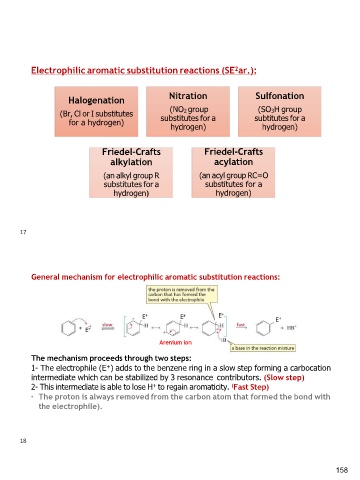
    General mechanism for electrophilic aromatic substitution reactions:

                              E+ E+ E+                          E+

    E+

                              Arenium ion

    The mechanism proceeds through two steps:
    1- The electrophile (E+) adds to the benzene ring in a slow step forming a carbocation
    intermediate which can be stabilized by 3 resonance contributors. (Slow step)
    2- This intermediate is able to lose H+ to regain aromaticity. (Fast Step)

    • The proton is always removed from the carbon atom that formed the bond with
      the electrophile).

18

                                                                                                                                  158

