


Page 125 - Pharmd general phytochemistry I-Final2024_LEUCTERS
P. 125
Aminoglycoside Antibiotics
Since the isolation of streptomycin in 1944, a great number of new Aminoglycoside
Antibiotics have been discovered.
Occurrence:
Aminoglycosides are isolated from the actinomycetes and particularly from the
genus Streptomyces, e.g.: streptomycin, kanamycin, neomycin, paromomycin,
gentamycin, and tobramycin. Amikacin is a semi-synthetic derivative of
kanamycin.
Chemical composition:
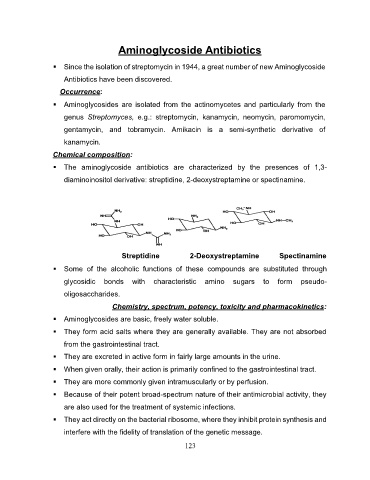
The aminoglycoside antibiotics are characterized by the presences of 1,3-
diaminoinositol derivative: streptidine, 2-deoxystreptamine or spectinamine.
Streptidine 2-Deoxystreptamine Spectinamine
Some of the alcoholic functions of these compounds are substituted through
glycosidic bonds with characteristic amino sugars to form pseudo-
oligosaccharides.
Chemistry, spectrum, potency, toxicity and pharmacokinetics:
Aminoglycosides are basic, freely water soluble.
They form acid salts where they are generally available. They are not absorbed
from the gastrointestinal tract.
They are excreted in active form in fairly large amounts in the urine.
When given orally, their action is primarily confined to the gastrointestinal tract.
They are more commonly given intramuscularly or by perfusion.
Because of their potent broad-spectrum nature of their antimicrobial activity, they
are also used for the treatment of systemic infections.
They act directly on the bacterial ribosome, where they inhibit protein synthesis and
interfere with the fidelity of translation of the genetic message.
123

