


Page 128 - Pharmd general phytochemistry I-Final2024_LEUCTERS
P. 128
BITTER PRINCIPLES AND OTHER MISCELLANEOUS NATURAL PRODUCTS
Bitter Principles are a group of natural products which are non-homogenous from
the chemical point of view, they have in common an intensely bitter taste and are
neither alkaloids nor glycosides.
They belong to different chemical groupings such as furanochromones,
furanocoumarins, sesquiterpene lactones, diterpenes, triterpenes, lignans, etc.
Bitter principles are mainly of vegetative origin, rarely of animal origin.
They essentially comprise of C, H, and O, but free from or rarely have N.
They are abundant in certain plant families especially Compositae, Labiatae and
Umbelliferae.
They were traditionally used in liquid medicaments to stimulate appetite as bitter
stomachic. It has been proposed that bitter principles stimulate the taste buds, thus
producing reflex secretion of gastric juices.
Many of these bitters and drugs containing them are still included in tonic formulations
and are usually administered before meals. However, they are now mainly used for
other pharmacological activities.
Terpenoids
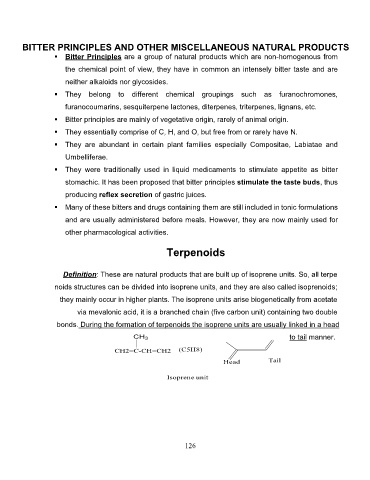
Definition: These are natural products that are built up of isoprene units. So, all terpe
noids structures can be divided into isoprene units, and they are also called isoprenoids;
they mainly occur in higher plants. The isoprene units arise biogenetically from acetate
via mevalonic acid, it is a branched chain (five carbon unit) containing two double
bonds. During the formation of terpenoids the isoprene units are usually linked in a head
CH3 to tail manner.
CH2=C-CH=CH2 (C5H8)
Head Tail
Isoprene unit
126

