


Page 133 - Pharmd general phytochemistry I-Final2024_LEUCTERS
P. 133
sesquiterpene lactones are first-line drugs for the treatment of cerebral malaria
caused by P. falciparun, which is otherwise fatal.
Dosing:
Artemisinin and derivatives have t1/2 on the order of an hour.
Therefore, they require at least daily dosing over several days.
For example, the WHO-approved adult dose of co-artemether is four tablets at 0, 8,
24, 36, 48, and 60 hours (six doses).
Recently, WHO has recommended Artemisinin Combination Therapy (ACT) as the
first-line therapy for P. falciparum malaria worldwide. Artemisinin kills the majority of
parasites at the start of treatment and the partner drug is a slowly eliminated drug
with long t1/2 to clear the remaining parasites.
Mechanism of Action:
The drug has a high affinity for hemozoin, a storage form of haem which is retained
by the parasite after digestion of hemoglobin, leading to a highly selective
accumulation of the drug in the parasite. Artemisinin then decomposes in the presence
of iron, probably from hemozoin and releases free radicals (hydrogen peroxide)
which kill the parasite. The peroxide bridge is therefore a crucial part of the drug
molecule as was suspected from structure activity studies.
Diterpenoids
Diterpenoids are C20 compounds biosynthesized in plants from four isoprene units
(provided by mevalonate or isopentenyl pyrophosphate units).
They are also of current interest because of their potentials as future drugs; either as
isolates from the plant or as modified derivatives.
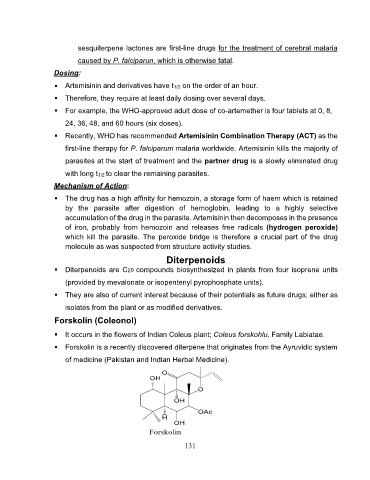
Forskolin (Coleonol)
It occurs in the flowers of Indian Coleus plant; Coleus forskohlu, Family Labiatae.
Forskolin is a recently discovered diterpene that originates from the Ayruvidic system
of medicine (Pakistan and Indian Herbal Medicine).
O O
OH OAc
OH
H
OH
Forskolin
131

