


Page 135 - Pharmd general phytochemistry I-Final2024_LEUCTERS
P. 135
Triterpenoids
Triterpenoids are C30 compounds which are abundant in nature. They may be
aliphatic, tetracyclic or pentacyclic.
Tetracyclic triterpenoids include limonoids, the sterols, cucurbitacins and quassinoids,
while pentacyclic triterpenoids are exemplified by saponins.
• Quassinoids are degradation and rearrangement products of triterpenes.
Bruceolides
They are another important group of quassinoids.
Source: Brucea javanica and Brucea antidysentrica (Family Simarubaceae).
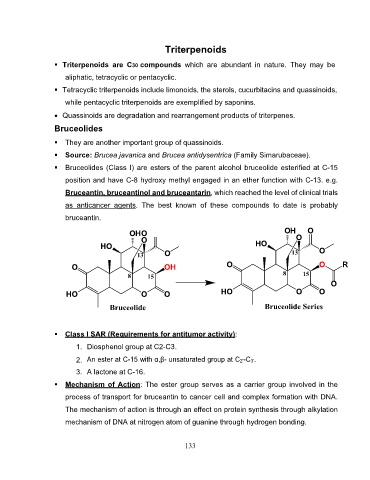
Bruceolides (Class I) are esters of the parent alcohol bruceolide esterified at C-15
position and have C-8 hydroxy methyl engaged in an ether function with C-13. e.g.
Bruceantin, bruceantinol and bruceantarin, which reached the level of clinical trials
as anticancer agents. The best known of these compounds to date is probably
bruceantin.
OHO OH O
HO O HO O
13 O 13 O
O OH
O OR
8 15
8 15
HO O O
Bruceolide O
HO O O
Bruceolide Series
Class I SAR (Requirements for antitumor activity):
1. Diosphenol group at C2-C3.
2. An ester at C-15 with α,β- unsaturated group at C2'-C3'.
3. A lactone at C-16.
Mechanism of Action: The ester group serves as a carrier group involved in the
process of transport for bruceantin to cancer cell and complex formation with DNA.
The mechanism of action is through an effect on protein synthesis through alkylation
mechanism of DNA at nitrogen atom of guanine through hydrogen bonding.
133

