


Page 137 - Pharmd general phytochemistry I-Final2024_LEUCTERS
P. 137
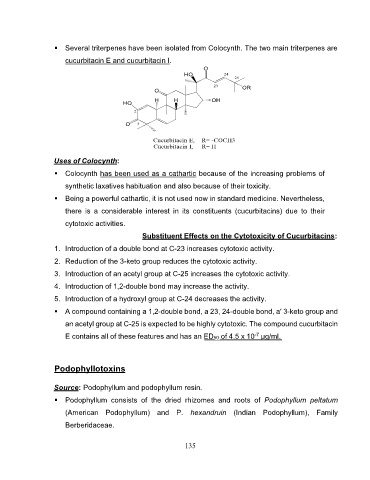
Several triterpenes have been isolated from Colocynth. The two main triterpenes are
cucurbitacin E and cucurbitacin I.
HO O
HO O 24
HH 25
2
23 OR
OH
O3
Cucurbitacin E, R= -COCH3
Cucurbitacin I, R= H
Uses of Colocynth:
Colocynth has been used as a cathartic because of the increasing problems of
synthetic laxatives habituation and also because of their toxicity.
Being a powerful cathartic, it is not used now in standard medicine. Nevertheless,
there is a considerable interest in its constituents (cucurbitacins) due to their
cytotoxic activities.
Substituent Effects on the Cytotoxicity of Cucurbitacins:
1. Introduction of a double bond at C-23 increases cytotoxic activity.
2. Reduction of the 3-keto group reduces the cytotoxic activity.
3. Introduction of an acetyl group at C-25 increases the cytotoxic activity.
4. Introduction of 1,2-double bond may increase the activity.
5. Introduction of a hydroxyl group at C-24 decreases the activity.
A compound containing a 1,2-double bond, a 23, 24-double bond, a' 3-keto group and
an acetyl group at C-25 is expected to be highly cytotoxic. The compound cucurbitacin
E contains all of these features and has an ED50 of 4.5 x 10⁻⁷ μg/ml.
Podophyllotoxins
Source: Podophyllum and podophyllum resin.
Podophyllum consists of the dried rhizomes and roots of Podophyllum peltatum
(American Podophyllum) and P. hexandruin (Indian Podophyllum), Family
Berberidaceae.
135

