


Page 144 - Pharmd general phytochemistry I-Final2024_LEUCTERS
P. 144
Mechanism of action: (Two possible mechanisms)
The exact topical mechanism of action is unknown. Psoralens given orally are
preferentially taken up by epidermal cells.
First mechanism: Psoralens sensitize the skin to the ultraviolet rays which act on the
melanocytes in the normal pigmented skin and around the vitiligo patches and stimulate
the melanin pigment to seep into the epidermal cells .
Second mechanism: It has been suggested that melanocytes in the hair follicles are
stimulated by psoralens to move up the follicle and to repopulate the epidermis.
Contraindications:
Patients with high blood pressure or a history of liver problems are at risk of inflammation
and irreparable damage to both liver and skin .
The eyes must be protected from UVB radiation.
Side effects:
Nausea, Headaches, Dizziness, Insomnia (in rare cases), Skin burning.
Increased risk of squamous cell carcinoma.
Lignan
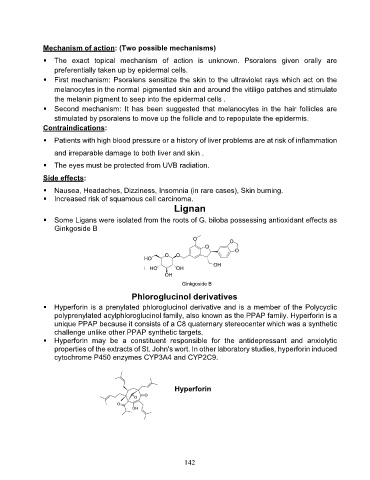
Some Ligans were isolated from the roots of G. biloba possessing antioxidant effects as
Ginkgoside B
Phloroglucinol derivatives
Hyperforin is a prenylated phloroglucinol derivative and is a member of the Polycyclic
polyprenylated acylphloroglucinol family, also known as the PPAP family. Hyperforin is a
unique PPAP because it consists of a C8 quaternary stereocenter which was a synthetic
challenge unlike other PPAP synthetic targets.
Hyperforin may be a constituent responsible for the antidepressant and anxiolytic
properties of the extracts of St. John's wort. In other laboratory studies, hyperforin induced
cytochrome P450 enzymes CYP3A4 and CYP2C9.
Hyperforin
142

