


Page 169 - Sanidhya 2025
P. 169
The CRPF’s Forward Bases


            Lifelines Transforming Tribal Healthcare in


            Chhattisgarh’s Bastar


            For generations, the tribal communities of Chhattisgarh’s
            Bastar region lived in a state of medical abandonment.
            Nestled in dense forests that were also Maoist
            strongholds, villages faced a harrowing reality:No
            motorable roads,distant health facilities and


                                                                 Inaccessible Facilities:Existing PHCs and CHCs
                                                               were concentrated in relatively secure semi-urban
                                                               areas, rendering them virtually unreachable for
                                                               remote tribal hamlets.
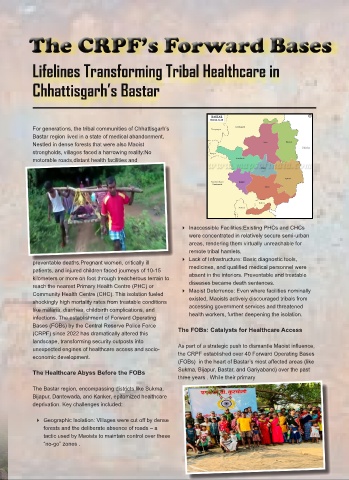
            preventable deaths.Pregnant women, critically ill       Lack of Infrastructure: Basic diagnostic tools,
            patients, and injured children faced journeys of 10-15   medicines, and qualified medical personnel were
            kilometers or more on foot through treacherous terrain to   absent in the interiors. Preventable and treatable
            reach the nearest Primary Health Centre (PHC) or   diseases became death sentences.
            Community Health Centre (CHC). This isolation fueled       Maoist Deterrence: Even where facilities nominally
            shockingly high mortality rates from treatable conditions   existed, Maoists actively discouraged tribals from
            like malaria, diarrhea, childbirth complications, and   accessing government services and threatened
            infections. The establishment of Forward Operating   health workers, further deepening the isolation.
            Bases (FOBs) by the Central Reserve Police Force
            (CRPF) since 2022 has dramatically altered this   The FOBs: Catalysts for Healthcare Access
            landscape, transforming security outposts into
            unexpected engines of healthcare access and socio-  As part of a strategic push to dismantle Maoist influence,
            economic development.                           the CRPF established over 40 Forward Operating Bases
                                                            (FOBs)  in the heart of Bastar’s most affected areas (like
            The Healthcare Abyss Before the FOBs            Sukma, Bijapur, Bastar, and Gariyaband) over the past
                                                            three years . While their primary
            The Bastar region, encompassing districts like Sukma,
            Bijapur, Dantewada, and Kanker, epitomized healthcare
            deprivation. Key challenges included:

                 Geographic Isolation: Villages were cut off by dense
               forests and the deliberate absence of roads – a
               tactic used by Maoists to maintain control over these
               “no-go” zones .

