


Page 199 - Atlas Sea Birds Ver1
P. 199
White-                        pusillus pusillus) annually killed 9% of the adult population
                            Bank               Crowned   Hartlaub's
                    Year             breasted                       of African Penguins in the mid-1990s and 7% in the mid-
                          Cormorant           Cormorant    Gull
                                    Cormorant                       2000s (Marks et al. 1997, Makhado et al. 2013). However,
                    1976     26        22                           when prey species shifted south and east at the recent turn
                    1977     25                  27                 of the century, there was a tendency for penguin colonies in
                    1979     113        7        11                 northwest South Africa to decrease and those in the south-
                    1980                                    1       west to increase. The ongoing decrease at Dyer Island was
                                                                    an exception to this pattern (Crawford et al. 2011). When
                    1996      0                                     the size of the penguin colony at Dyer Island was > 3,500
                    2006      0                             0       pairs, numbers of penguins breeding there were negatively
                    2007                                    0       related to sardine catches made within 20 nautical miles of
                    2008                                    0       the island, suggesting an influence of local exploitation of
                    2009                                    0       prey species on the colony (Ludynia et al. 2014). In 2004,
                    2010                                    0       70,000 tonnes of sardine were caught within 20 nautical
                    2011      0         0         0         0       miles of Dyer Island (Ludynia et al. 2014) and in 2002 and
                    2012      0         0                   0       from 2005–2007 the exploitation rate of sardine west of
                    2013      0         0                   0       Cape Agulhas was 30–44% (Coetzee et al. 2008). In ad-
                    2014      0         0                   0       dition  to substantially  depleting  local  availability  of prey,
                    2015      0         0                   0       the heavy fishing in the area may have caused sardine to
                                                                    shift farther east (Coetzee et al. 2008), beyond the foraging
                    2016      0         0                   0       range of African Penguins.
                    2017      0         0         0         0         Since 1978, Dyer Island has held large numbers of
                    2018      0         0         0         0       Cape Cormorants, almost 50,000 pairs in 1985. In  the
                    2019      0         0         0                 2010s,  54%  of  South Africa’s  Cape  Cormorants  bred  at
                                                                    Dyer Island (Crawford et al. 2016). In 1956, the island had
                  Dyer Island                                       a colony of c. 100 pairs of Bank Cormorants. In 2005, 30
                  Coordinates: 34.6818 S; 19.4190 E                 pairs bred at the island but this dwindled to just one pair
                  Description: A relatively flat island c. 20 ha in extent that   in 2021.
                  rises to a height of c. 6 m. It has mixed vegetation over   In 1996, 19 pairs of Leach’s Storm Petrel were found
                  a pebble-covered surface. Buildings at the northeast end   breeding in dry stone walls around the island’s settlement,
                  housed  staff,  stores  and  boats  (Rand  1963).  Dry-stone   which was the first record of the species breeding in the
                  walls  were  built  around the settlement and there was   southern hemisphere (Whittington et al. 1999). However,
                  a furnace to render seal blubber to oil. The island is still   after 1998 numbers decreased and since 2005 no petrels
                  staffed and has a jetty near the buildings.       were observed breeding at the island. Up to 108 pairs (in
                     Seabird guano was collected at Dyer Island in 76 years   2005) of White-breasted Cormorant, 266 pairs (in 2007) of
                  between 1896 and 1995, the total quantity removed from   Crowned Cormorant, 610 pairs (in 2012) of Kelp Gull, 430
                  the island in that period being 14,060 metric tons (Tom et   pairs (in 2014) of Hartlaub’s Gull, four pairs (in 1991) of
                  al. 2024).                                        Grey-headed Gull, 6,722 pairs (in 2006) of Greater Crested
                     Between 1875 and 1941, 217,180  African Penguin   Tern, 21 pairs (in 2012) of Caspian Tern and 47 pairs (in
                  eggs were harvested at the island (Makhado et al. 2024).   2020) of Roseate Tern have bred at the island, emphasis-
                  Conservation status: It was gazetted as the Dyer Island   ing its importance for seabirds of the region. Great White
                  Provincial Nature Reserve in 1988 (Province of the Cape   Pelicans bred in unknown numbers at Dyer Island in the
                  of Good Hope 1988) and is administered by CapeNature.   1800s  and early  1900s, but persecution  of pelicans  by
                  Species and numbers breeding:  Fourteen of the     guano collectors caused then to abandon Dyer Island and
                  15 seabirds that breed in the BUS have bred or attempted   move to Seal Island in False Bay after 1919 (Crawford et
                  to breed at Dyer Island, the exception being Damara Tern,   al. 1995b).
                  which in South Africa has only been recorded nesting on
                  the mainland (Martin et al. 2024). Cape Gannets roosted at
                  Dyer Island in large numbers in 1984 (Berruti 1985) and did
                  so again in 1985, when a single nest with an abandoned
                  egg  was  found  (Crawford  et  al.  1986).  Known  breeding
                  attempts and numbers breeding for the other 13 species
                  are shown on the following Dyer Island table.
                     About 4,000 pairs of African Penguin bred at the island
                  in 1958, which increased to > 22,000 pairs in 1979 (Rand
                  1963,  Shelton  et  al.  1984)  and  remained  above  18,000
                  pairs in 1986.  The  number breeding then decreased to
                  fewer than 2,000 pairs after 2006. In the late 20th century,
                  there was emigration of penguins fledged at Dyer Island to
                  colonies farther west (Crawford et al. 1995a, Whittington et
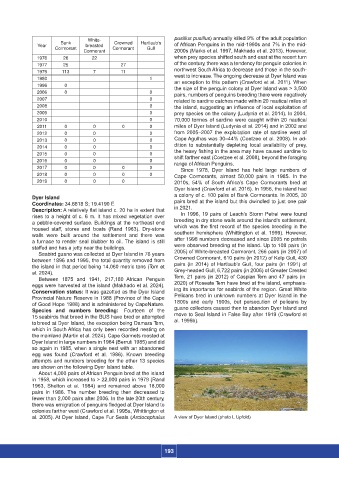
                  al. 2005). At Dyer Island, Cape Fur Seals (Arctocephalus   A view of Dyer Island (photo L Upfold)


                                                                 193

