


Page 526 - Atlas Sea Birds Ver1
P. 526
3.13  Numbers, trends, status, and conservation of Greater
                           Crested Tern (Thalasseus b. bergii) breeding coastally in
                           southern Africa


                  Authors: RJM Crawford, BM Dyer, AP Martin,  DB Tom, L Upfold, JL Visagie, and AB Makhado
                  Abstract:
                  The nominate race of Greater Crested Tern (Thalasseus bergii) is endemic to the Benguela upwelling ecosystem off southwest Africa.
                  There it bred at 36 sites, 10 in Namibia and 26 in South Africa. An increased availability of prey off South Africa enabled their overall
                  population to increase from < 7,000 pairs during 1985–2003 to > 15,000 pairs in 2010 and 2015. The increase was most plausibly attributed
                  to good recruitment to the breeding population and a greater proportion of mature birds breeding. An ability to move between breeding
                  sites enabled rapid adjustment to an altered distribution of prey in the early 2000s. About 6,900 pairs bred in 2022. The conservation status
                  of the global population and the nominate race is considered to be Least Concern. Thirteen of the breeding sites held > 1,000 pairs in at
                  least one season. Since 2010, 17 sites have held > 1% of the 2022 population, of which three fall outside protected areas. Consideration
                  should be given to recognising the other 14 sites as regional Important Bird and Biodiversity Areas. Threats to the population include food
                  scarcity, loss of suitable breeding habitat, disturbance by humans at colonies, and pathogenic avian diseases.
                  Introduction:
                  The Greater Crested Tern (Thalasseus bergii) is a marine tern that breeds at archipelagos in the central, west Pacific Ocean, around
                  Australia, in southeast Asia, in the north Indian Ocean, in the Middle East, at archipelagos in the west Indian Ocean, around Madagascar,
                  and along the east and south coasts of Africa. Its breeding distribution extends into the Benguela upwelling system (BUS) in southwest
                  Africa and around Cape Agulhas, at the southern tip of Africa, into the southeast Atlantic Ocean. It does not breed elsewhere in the Atlantic
                  (Del Hoyo et al. 1996). In 1996, it was thought there were more than 500,000 pairs in Australia and about 50,000 pairs elsewhere (del Hoyo
                  et al. 1996). Later the global population of the species was estimated to number c.150,000–1,100,000 individuals and, from a conservation
                  perspective, was classified as Least Concern in terms of Red List criteria of the International Union for Conservation of Nature (IUCN,
                  BirdLife International 2022).
                     The nominate race of the species,T. bergii, constituted a discrete population of the species (Cooper et al. 1990) and bred only in the
                  BUS between Swakopmund in central Namibia and Algoa Bay on the south coast of South Africa (Figure 1). Some non-breeding birds
                  move north to southern Angola (Dyer 2007) and east to southern Mozambique (del Hoyo et al. 1996). Small numbers of Greater Crested
                  Terns were recorded at Lake St Lucia in northeast South Africa in 31 of the 42 years between 1976 and 2021 when bird counts there were
                  undertaken (Fox et al. 2024).
                     In southern Africa, Greater Crested Terns have bred at 36 sites, of which 10 were in Namibia and 26 in South Africa (Figure 1). These
                  included coastal islands as well as mainland sites, amongst which were salt and sewage works (e.g. Uys 1978, Martin and Whittington
                  2024, Tom et al. 2024a), roofs of buildings at Sandy Point, Saldanha harbour, Cape Town waterfront (Crawford and Dyer 2000, Roberts
                  2018) and Somerset Hospital, and a fenced off abalone (Haliotis midae) farm. They showed low fidelity to breeding sites, which was
                  attributed to their requirement to nest near to fish prey, and often bred with other seabirds, whose presence likely indicated safe nesting
                  sites (Crawford 2003). Most breeding took place from January to June (Crawford et al. 2002).
                     In  the  BUS,  Greater  Crested  Terns  fed  mainly  on  epipelagic  fish  species,  including  anchovy  (Engraulis encrasicolus),  redeye
                  round-herring (Etrumeus whiteheadii), and sardine (Sardinops sagax) that were exploited by commercial fisheries, and Atlantic saury
                  (Scomberesox saurus) (Crawford and Dyer 1995 and Gaglio et al. 2017, 2018).
                     This chapter collates estimates of numbers of Greater Crested Terns breeding at different sites. It makes a preliminary assessment of
                  the Red List status of, identifies Important Bird and Biodiversity Areas (IBAs) for, and summarises threats to the population of the nominate
                  race.
                  Numbers and distribution                          percentages of the total of most recent counts contributed
                                                                    by each site. As Greater Crested Terns may move breeding
                  Numbers of Greater Crested Terns estimated to have bred   sites between years (Cooper et al. 1990, Crawford et al.
                  annually from 1923–2022 at different sites in Namibia and   1994, Crawford 2009), and even within  years (Kemper
                  South Africa are shown in Table 1. Information was collated   et al. 2007), the sum of most recent counts at sites may
                  from Rand (1963), Randall et al. (1981), Williams (1987),   overestimate the population.
                  Cooper et al. (1990), Crawford and Dyer (2000), Crawford
                  (2009),  Crawford  et al. (2009),  and  relevant  breeding
                  site chapters in this volume. When multiple counts were
                  obtained at a site in a given year, the maximum was used.
                  When a range was given the mid-point was used.
                     In 1984, the breeding  population  of  T. bergii was
                  estimated to be 4,835 pairs at 22 sites (Table 2) but 6,088
                  pairs bred at three sites in 1988 (Cooper et al 1990). In
                  2006 and 2007, the population was 8,924  pairs (Table 2,
                                                    1
                  Kemper et al. 2007). Crawford (2009) listed counts made
                  at South African colonies from 1984–2008; those for 2000
                  and 2008 are shown  in  Table  2. Also shown  in  Table  2
                  are the maximum  values  and  most recent counts made
                  for each site, the sum of the most recent counts,and the
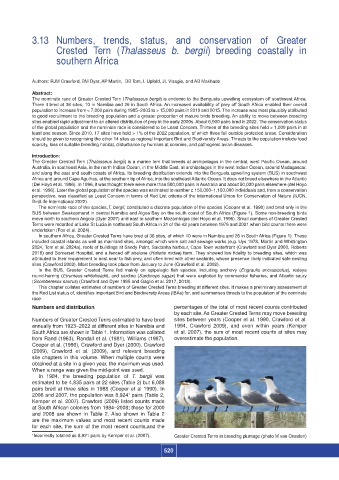
                  1 Incorrectly totalled as 8,921 pairs by Kemper et al. (2007).  Greater Crested Terns in breeding plumage (photo M van Onselen)


                                                                 520

