


Page 528 - Atlas Sea Birds Ver1
P. 528
The largest number estimated to  breed at  a  site was   18000
                  12,986 pairs at Robben Island. Twelve other sites held >   16000  Benguela upwelling ecosytem
                  1,000 pairs (maxima are shown after the site name): Dyer
                  Island (6,722 pairs), Dassen Island (4,946 pairs), Danger   14000
                  Point Abalone Farm (4,680 pairs), Cape Town waterfront   12000
                  (4,000 pairs), Malgas Island (3,308 pairs), Schaapen
                  Island (3,246 pairs), Jutten Island (3,012 pairs), Saldanha   10000
                  harbour (2,130 pairs), Possession Island (1,678 pairs),   Pairs  8000
                  Ichaboe Island (1,571 pairs), Meeuw Island (1,500 pairs),
                  and Halifax Island (1,003 pairs).  Ichaboe, Halifax, and   6000
                  Possession  islands are in south Namibia  and fall within   4000
                  the  Namibian Islands’  Marine Protected  Area (NIMPA).
                  The other ten sites are in southwest South Africa, west   2000
                  of Cape Agulhas. Malgas, Jutten, and Schaapen islands
                  are in South Africa’s West Coast National Park (WCNP).  1984  1988  1992  1996  2000  2004  2008  2012  2016  2020
                  Meeuw Island is adjacent to WCNP and managed  as a
                  conservation area.  Dassen and  Dyer islands are nature   Figure 2. Numbers (pairs) of Greater Crested Terns breeding in
                  reserves. Robben Island is a National Historical Monument   Southern Africa annually, 1984–2022. Not all sites were visited in
                  that  is managed primarily for  its  historical and cultural   every year (see Table 1). Gaps indicate years that lack data for
                  values and offers less protection to colonies than NIMPA,   substantial portions of the overall population
                  WCNP, and the nature reserves. Saldanha harbour, Cape
                  Town waterfront, and Danger Point Abalone Farm are not   1987 and 1988 the average number of chicks fledged per
                  protected.                                        pair was between  0.48 and 0.59 (Crawford  et al. 2002).
                     East of Cape Agulhas, Greater Crested Terns bred at   In South Africa, annual survival of Greater Crested Terns
                  Seal Island (Mossel Bay) in 1923 (Rand 1963) and more   in their first year (S ) was 0.52, in their second year (S )
                                                                                    0
                                                                                                                 1
                  recently at saltworks in two estuaries and at three islands   0.77 and in their third year (S ) 0.80 (Underhill et al. 1999).
                                                                                           2
                  in Algoa Bay (Crawford et al. 2009, Martin and Whittington   No estimates of  adult survival (S )  have been made in
                                                                                                a
                  2024).                                            the BUS, but in Australia S  was assumed to be 0.94 per
                                                                                          a
                                                                    annum (Dunlop 1985).
                  Population trend and conservation status            The breeding  population  of  T. bergii  has  fluctuated
                                                                    substantially  but  has  shown  no  long-term  trend
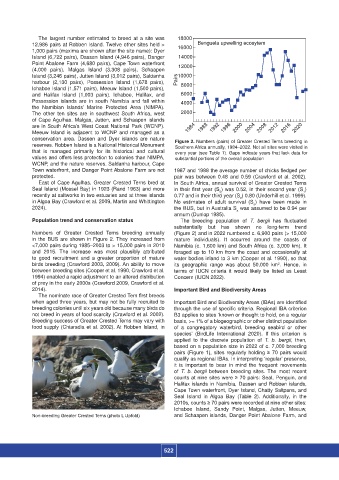
                  Numbers of Greater Crested  Terns breeding  annually   (Figure 2) and in 2022 numbered c. 6,900 pairs (> 15,000
                  in the BUS are shown in Figure 2. They increased  from   mature individuals).  It occurred  around  the coasts of
                  <7,000 pairs during 1985–2003 to > 15,000 pairs in 2010   Namibia (c. 1,600 km) and South Africa (c. 3,000 km). It
                  and 2015.  The increase  was most plausibly  attributed   foraged up to  10  km  from  the  coast  and occasionally  at
                  to  good recruitment and a greater proportion of  mature   water bodies inland to 3 km (Cooper et al. 1990), so that
                  birds breeding (Crawford 2003, 2009). An ability to move   its geographic  range was about 50,000 km .  Hence, in
                                                                                                         2
                  between breeding sites (Cooper et al. 1990, Crawford et al.   terms  of  IUCN criteria it  would likely be listed as  Least
                  1994) enabled a rapid adjustment to an altered distribution   Concern (IUCN 2022).
                  of prey in the early 2000s (Crawford 2009, Crawford et al.
                  2014).                                            Important Bird and Biodiversity Areas
                     The nominate race of Greater Crested Tern first breeds
                  when aged three years, but may not be fully recruited to   Important Bird and Biodiversity Areas (IBAs) are identified
                  breeding colonies until six years old because many birds do   through the use of specific criteria. Regional IBA criterion
                  not breed in years of food scarcity (Crawford et al. 2002).   B3 applies to sites ‘known or thought to hold, on a regular
                  Breeding success of Greater Crested Terns may vary with   basis, >= 1% of a biogeographic or other distinct population
                  food supply (Chiaradia et al. 2002). At Robben Island, in   of a congregatory  waterbird, breeding  seabird or other
                                                                    species’  (BirdLife International 2020). If  this criterion is
                                                                    applied  to the discrete population  of  T. b. bergii,  then,
                                                                    based on a population size in 2022 of c. 7,000 breeding
                                                                    pairs (Figure 1), sites regularly holding ≥ 70 pairs would
                                                                    qualify as regional IBAs. In interpreting ‘regular’ presence,
                                                                    it is important to bear in mind the frequent movements
                                                                    of  T. b. bergii between  breeding sites.  The most recent
                                                                    counts at nine sites were ≥ 70 pairs: Seal, Penguin, and
                                                                    Halifax islands in Namibia, Dassen and Robben islands,
                                                                    Cape Town waterfront, Dyer Island, Chatty Saltpans, and
                                                                    Seal Island in  Algoa Bay (Table 2).  Additionally, in the
                                                                    2010s, counts ≥ 70 pairs were recorded at nine other sites:
                                                                    Ichaboe  Island, Sandy  Point, Malgas,  Jutten, Meeuw,
                  Non-breeding Greater Crested Terns (photo L Upfold)  and Schaapen islands, Danger Point Abalone Farm, and


                                                                 522

