


Page 529 - Atlas Sea Birds Ver1
P. 529
Stag and Bird (Algoa Bay) islands (Table 1). It may prove   An expansion  of Lüderitz Harbour in the late 1990s,
                  difficult  to  manage  the  Sandy  Point  fish  factory,  Cape   consequent increased  activities around the harbour,  and
                  Town waterfront,  and Danger Point  Abalone  Farm,  but   a simultaneous  increase in the numbers of feral cats
                  consideration  should be given to  recognising  the other     (Felis catus) there may have displaced  Greater Crested
                  15 sites as regional IBAs for the nominate race.  Terns from Lüderitz Harbour  and Shark Island to breed
                                                                    at Penguin, Seal, and Halifax islands (Tom et al. 2024b).
                  Conservation issues                               Feral cats displaced Greater Crested Terns from breeding
                                                                    at Robben Island in 1997 and 1998 (Crawford and Kroese
                  Trends in the overall population of T. b. bergii have been   2000). Greater Crested  Terns were susceptible  to an
                  largely driven by food abundance and availability. Hence,   outbreak  ofhighly  pathogenic  avian  influenza  (HPAI)  in
                  sufficient forage and suitable breeding habitat near to the   2017  and 2018  (Khomenko  et al. 2018).Then,  of 7,560
                  prey resources are a sine qua non for the population. Nests   wild  birds  infected  or suspected  to be infected  by HPAI,
                  on islands in saltworks are vulnerable to changing water   5,363 were Greater Crested Terns and the disease killed
                  levels that may flood them or, by receding, increase their   an  estimated  1,700  chicks  at a colony  at Cape  Town
                  accessibility  to predators. Greater Crested Terns bred at   waterfront (Roberts 2018). In 2003, 103 Greater Crested
                  Mile 4 Saltworks in 1986 (Williams 1987) but subsequently   Terns that were incapacitated by marine foam (generated
                  the nature of the evaporation pans changed, they became   by wave action, kelp mucilage, and phytoplankton) were
                  more flooded and there was no longer suitable habitat for   rescued at Robben Island, of which 93 were released back
                  nesting (Tom et al. 2024a).                       to the wild after rehabilitation (Parsons et al. 2006).


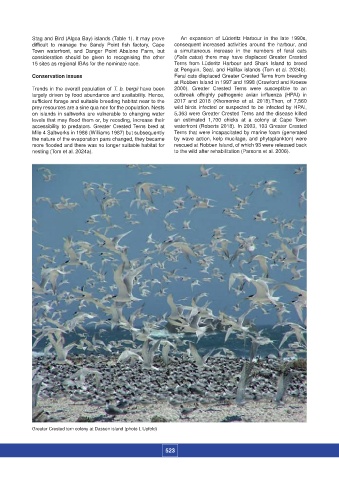
                  Greater Crested tern colony at Dassen island (photo L Upfold)


                                                                 523

