


Page 585 - Atlas of Creation Volume 1
P. 585
Harun Yahya


               DIFFERENT HUMAN RACES THAT LIVED                               NEANDERTHAL:
                                                                               NEANDERTHAL:
               IN HISTORY COMPOSE NO EVIDENCE
               FOR EVOLUTION!
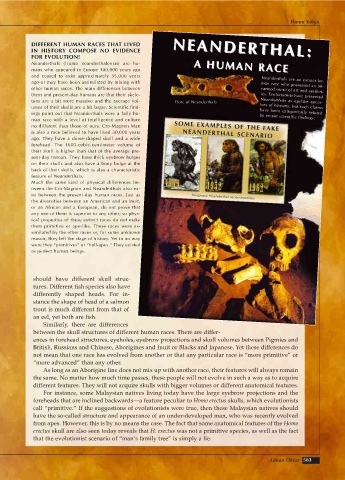
               Neanderthals (Homo neanderthalensis) are hu-
                                                                                        A HUMAN RACE
                                                                                        A HUMAN RACE
               mans who appeared in Europe 100,000 years ago
               and ceased to exist approximately 35,000 years
                                                                                                                      Neanderthals are an extinct hu-
               ago-or may have been assimilated by mixing with
                                                                                                                      man race who possessed an ad-
               other human races. The main differences between                                                        vanced sense of art and aesthet-
               them and present-day humans are that their skele-                                                      ics. Evolutionists have presented
               tons are a bit more massive and the average vol-                Flute of Neanderthals                  Neanderthals as apelike ances-
               umes of their skulls are a bit larger. Scientific find-                                                tors of humans, but such claims
               ings point out that Neanderthals were a fully hu-                                                      have been categorically refuted
                                                                                                                      by recent scientific findings.
               man race with a level of intelligence and culture
               no different than those of ours. Cro-Magnon Man                 SOME EXAMPLES OF THE FAKE
                                                                               SOME EXAMPLES OF THE FAKE
               is also a race believed to have lived 30,000 years                  NEANDERTHAL SCENARIO
                                                                                   NEANDERTHAL SCENARIO
               ago. They have a dome-shaped skull and a wide
               forehead. The 1600-cubic-centimeter volume of
               their skull is higher than that of the average pre-
               sent-day human. They have thick eyebrow bulges
               on their skulls and also have a bony bulge at the
               back of their skulls, which is also a characteristic
               feature of Neanderthals.
               Much the same kind of physical differences be-
               tween the Cro-Magnon and Neanderthals also ex-
               ist between the present-day human races. Just as                        Imaginary Neanderthal reconstructions
               the diversities between an American and an Inuit,
               or an  African and a European, do not prove that
               any one of them is superior to any other; so phys-
               ical properties of these extinct races do not make
               them primitive or ape-like. These races were as-
               similated by the other races or, for some unknown
               reason, they left the stage of history. Yet in no way
               were they “primitives” or “half-apes.” They existed
               as perfect human beings.


                should have different skull struc-

                tures. Different fish species also have
                differently shaped heads. For in-
                stance the shape of head of a salmon
                trout is much different from that of
                an eel, yet both are fish.
                    Similarly, there are differences
                between the skull structures of different human races. There are differ-
                ences in forehead structures, eyeholes, eyebrow projections and skull volumes between Pigmies and
                British, Russians and Chinese, Aborigines and Inuit or Blacks and Japanese. Yet these differences do

                not mean that one race has evolved from another or that any particular race is “more primitive” or
                “more advanced” than any other.
                    As long as an Aborigine line does not mix up with another race, their features will always remain
                the same. No matter how much time passes, these people will not evolve in such a way as to acquire
                different features. They will not acquire skulls with bigger volumes or different anatomical features.
                    For instance, some Malaysian natives living today have the large eyebrow projections and the
                foreheads that are inclined backwards—a feature peculiar to Homo erectus skulls, which evolutionists

                call “primitive.” If the suggestions of evolutionists were true, then these Malaysian natives should
                have the so-called structure and appearance of an under-developed man, who was recently evolved
                from apes. However, this is by no means the case. The fact that some anatomical features of the Homo
                erectus skull are also seen today reveals that H. erectus was not a primitive species, as well as the fact
                that the evolutionist scenario of “man’s family tree” is simply a lie.


                                                                                                                          Adnan Oktar    583

