


Page 589 - Atlas of Creation Volume 1
P. 589
Harun Yahya


              realized that the KNM-ER 1470 skull’s hu-                        THE TALE OF LUCY
                                                                               THE TALE OF LUCY
              man-like face, which frequently appeared on

              the covers of scientific journals and popular
                                                                                          VANISHED
              scientific magazines, was the result of an in-                             VANISHED
              correct assembly of skull fragments—which
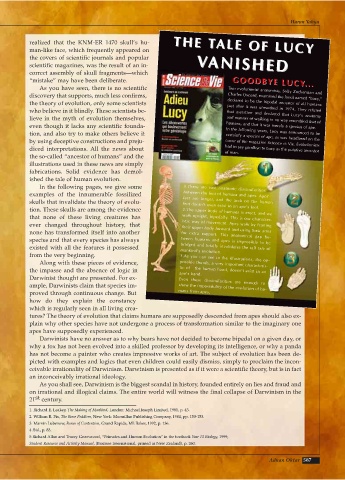
              “mistake” may have been deliberate.                                                        GOODBYE LUCY...
                                                                                                         GOODBYE LUCY...
                   As you have seen, there is no scientific                                            Two evolutionist anatomists, Solly Zuckerman and
              discovery that supports, much less confirms,                                             Charles Oxnard, examined the fossil named “Lucy,”
              the theory of evolution, only some scientists                                            declared to be the bipedal ancestor of all humans
                                                                                                       just after it was unearthed in 1974. They refuted
              who believe in it blindly. These scientists be-                                          that assertion and declared that Lucy's anatomy
              lieve in the myth of evolution themselves,                                               and manner of walking in no way resembled that of

              even though it lacks any scientific founda-                                              humans, and that it was merely a species of ape.
              tion, and also try to make others believe it                                            In the following years, Lucy was announced to be
                                                                                                      certainly a species of ape, as was headlined on the
              by using deceptive constructions and preju-                                             cover of the magazine Science et Vie. Evolutionists
              diced interpretations.  All the news about                                              had to say goodbye to Lucy as the putative ancestor
                                                                                                      of man.
              the so-called “ancestor of humans” and the
              illustrations used in these news are simply
              fabrications. Solid evidence has demol-

              ished the tale of human evolution.
                   In the following pages, we give some                             1.There are vast anatomic dissimilarities
              examples of the innumerable fossilized                               between the feet of humans and apes. Apes'
              skulls that invalidate the theory of evolu-                          feet are longer, and the arch on the human
                                                                                   feet doesn't even exist in an ape's foot.
              tion. These skulls are among the evidence                            2.The upper body of humans is erect, and we
              that none of these living creatures has                              walk upright, bipedally. This is our character-
              ever changed throughout history, that                                istic way of movement. Apes walk by leaning
                                                                                   their upper body forward and using their arms
              none has transformed itself into another                            for extra support. This anatomical gap be-
              species and that every species has always                           tween humans and apes is impossible to be

              existed with all the features it possessed                          bridged and totally invalidates the tall tale of
                                                                                  mankind's evolution.
              from the very beginning.                                            3.As you can see in the illustrations, the op-
                   Along with these pieces of evidence,                           posable thumb, a very important characteris-
              the impasse and the absence of logic in                             tic of   the human hand, doesn't exist in an
                                                                                 ape's hand.
              Darwinist thought are presented. For ex-                           Even these dissimilarities are enough to
              ample, Darwinists claim that species im-                           show the impossibility of the evolution of hu-
              proved through continuous change. But                              mans from apes.

              how do they explain the constancy
              which is regularly seen in all living crea-
              tures? The theory of evolution that claims humans are supposedly descended from apes should also ex-
              plain why other species have not undergone a process of transformation similar to the imaginary one
              apes have supposedly experienced.
                   Darwinists have no answer as to why bears have not decided to become bipedal on a given day, or
              why a fox has not been evolved into a skilled professor by developing its intelligence, or why a panda
              has not become a painter who creates impressive works of art. The subject of evolution has been de-
              picted with examples and logics that even children could easily dismiss, simply to proclaim the incon-

              ceivable irrationality of Darwinism. Darwinism is presented as if it were a scientific theory, but is in fact
              an inconceivably irrational ideology.
                   As you shall see, Darwinism is the biggest scandal in history, founded entirely on lies and fraud and
              on irrational and illogical claims. The entire world will witness the final collapse of Darwinism in the
              21 st  century.

              1. Richard E. Leakey, The Making of Mankind, London: Michael Joseph Limited, 1981, p. 43.
              2. William R. Fix, The Bone Peddlers, New York: Macmillan Publishing Company, 1984, pp. 150-153.
              3. Marvin Lubenow, Bones of Contention, Grand Rapids, MI: Baker, 1992, p. 136.
              4 Ibid., p. 83.
              5 Richard Allan and Tracey Greenwood, “Primates and Human Evolution” in the textbook Year 13 Biology, 1999,
              Student Resource and Activity Manual, (Biozone International, printed in New Zealand), p. 260.


                                                                                                                          Adnan Oktar    587

