


Page 586 - Atlas of Creation Volume 1
P. 586
In brief, the fact that some races of humans who lived in the past have different anatomical struc-
                     tures is no evidence for evolution. Anatomical differences can be seen in every age, between every dif-
                     ferent human race. The skulls of Americans and Japanese, Europeans and Aborigines, Inuit, Blacks or
                     Pygmies are not the same. Yet this does not suggest that any of these races is more advanced or more
                     primitive than any other.
                          If, thousands of years later, a scientist finds the skull of an American 1.90 meters tall who lived in
                     the 2000s and decides to compare it with the skull of a Japanese 1.60 meters in height who also lived in
                     the 21st century, he will observe many differences, the size being the first.

                          If, based on these differences, he claims that Americans were more advanced in the imaginary evo-
                     lutionary process while Japanese were simply primitive hominids, his interpretation will surely be far
                                                                                        from reflecting the truth.
                                                                                             Moreover, size of a skull is no measure of
                                                                                        a human being’s intelligence or skills. Many
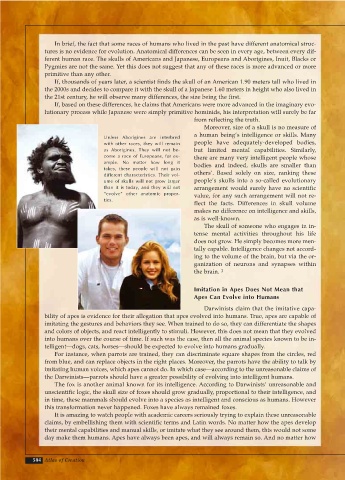
                                                Unless  Aborigines are interbred
                                                with other races, they will remain      people have adequately-developed bodies,
                                                as  Aborigines. They will not be-       but limited mental capabilities. Similarly,
                                                come a race of Europeans, for ex-       there are many very intelligent people whose
                                                ample. No matter how long it            bodies and indeed, skulls are smaller than
                                                takes, these people will not gain
                                                different characteristics. Their vol-   others’. Based solely on size, ranking these
                                                ume of skulls will not grow larger      people’s skulls into a so-called evolutionary
                                                than it is today, and they will not     arrangement would surely have no scientific
                                                “evolve” other anatomic proper-         value, for any such arrangement will not re-
                                                ties.
                                                                                        flect the facts. Differences in skull volume
                                                                                        makes no difference on intelligence and skills,
                                                                                        as is well-known.

                                                                                             The skull of someone who engages in in-
                                                                                        tense mental activities throughout his life
                                                                                        does not grow. He simply becomes more men-
                                                                                        tally capable. Intelligence changes not accord-
                                                                                        ing to the volume of the brain, but via the or-
                                                                                        ganization of neurons and synapses within
                                                                                        the brain.  3


                                                                                        Imitation in Apes Does Not Mean that
                                                                                        Apes Can Evolve into Humans


                                                                                             Darwinists claim that the imitative capa-
                     bility of apes is evidence for their allegation that apes evolved into humans. True, apes are capable of
                     imitating the gestures and behaviors they see. When trained to do so, they can differentiate the shapes
                     and colors of objects, and react intelligently to stimuli. However, this does not mean that they evolved
                     into humans over the course of time. If such was the case, then all the animal species known to be in-
                     telligent—dogs, cats, horses—should be expected to evolve into humans gradually.
                          For instance, when parrots are trained, they can discriminate square shapes from the circles, red
                     from blue, and can replace objects in the right places. Moreover, the parrots have the ability to talk by

                     imitating human voices, which apes cannot do. In which case—according to the unreasonable claims of
                     the Darwinists—parrots should have a greater possibility of evolving into intelligent humans.
                          The fox is another animal known for its intelligence. According to Darwinists’ unreasonable and
                     unscientific logic, the skull size of foxes should grow gradually, proportional to their intelligence, and
                     in time, these mammals should evolve into a species as intelligent and conscious as humans. However
                     this transformation never happened. Foxes have always remained foxes.
                          It is amazing to watch people with academic careers seriously trying to explain these unreasonable

                     claims, by embellishing them with scientific terms and Latin words. No matter how the apes develop
                     their mental capabilities and manual skills, or imitate what they see around them, this would not some
                     day make them humans. Apes have always been apes, and will always remain so. And no matter how


                584 Atlas of Creation

