


Page 588 - Atlas of Creation Volume 1
P. 588
Nebraska near Snake Brook. This tooth allegedly bore the common characteristics of both man and ape,

                     and came from a new species dubbed “Nebraska Man.” Based on this single tooth, reconstructions of
                     Nebraska Man’s head and body were conjectured. Moreover, Nebraska Man was even pictured with his
                     entire family! But in 1927, other parts of the skeleton were also found, and these newly discovered
                     pieces showed that the tooth belonged neither to a man nor to an ape, but to an extinct species of wild
                     American pig called Prosthennops.
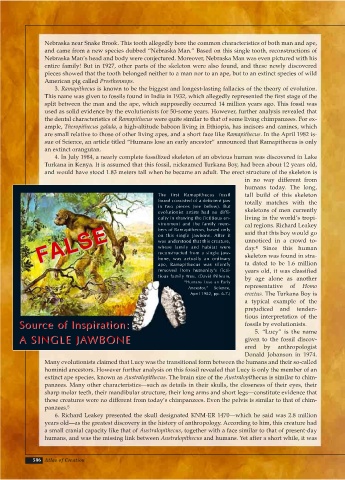
                          3. Ramapithecus is known to be the biggest and longest-lasting fallacies of the theory of evolution.
                     This name was given to fossils found in India in 1932, which allegedly represented the first stage of the
                     split between the man and the ape, which supposedly occurred 14 million years ago. This fossil was
                     used as solid evidence by the evolutionists for 50-some years. However, further analysis revealed that

                     the dental characteristics of Ramapithecus were quite similar to that of some living chimpanzees. For ex-
                     ample, Theropithecus galada, a high-altitude baboon living in Ethiopia, has incisors and canines, which
                     are small relative to those of other living apes, and a short face like Ramapithecus. In the April 1982 is-
                     sue of Science, an article titled “Humans lose an early ancestor” announced that Ramapithecus is only
                     an extinct orangutan.
                          4. In July 1984, a nearly complete fossilized skeleton of an obvious human was discovered in Lake
                     Turkana in Kenya. It is assumed that this fossil, nicknamed Turkana Boy, had been about 12 years old,

                     and would have stood 1.83 meters tall when he became an adult. The erect structure of the skeleton is
                                                                                                               in no way different from
                                                                                                               humans today. The long,
                                                                        The first Ramapithecus     fossil      tall build of this skeleton
                                                                        found consisted of a deficient jaw     totally matches with the
                                                                        in two pieces (see below). But
                                                                        evolutionist artists had no diffi-     skeletons of men currently
                                                                        culty in drawing the fictitious en-    living in the world’s tropi-
                                                                        vironment and the family mem-          cal regions. Richard Leakey
                  FALSE                                                 on this single jawbone.  After it      unnoticed in a crowd to-
                   FALSE
                                                                        bers of Ramapithecus, based only
                                                                                                               said that this boy would go
                                                                        was understood that this creature,
                                                                        whose family and habitat were
                                                                                                               day.
                                                                                                                       Since this human
                                                                                                                    4
                                                                        reconstructed from a single jaw-
                                                                                                               skeleton was found in stra-
                                                                        bone, was actually an ordinary
                                                                        ape, Ramapithecus was silently
                                                                        removed from humanity's ficti-         ta dated to be 1.6 million
                                                                                                               years old, it was classified
                                                                        tious family tree.  (David Pilbeam,    by age alone as another
                                                                                    “Humans Lose an Early
                                                                                      Ancestor,”  Science,     representative of  Homo
                                                                                      April 1982, pp. 6-7.)    erectus. The Turkana Boy is
                                                                                                               a typical example of the
                                                                                                               prejudiced and tenden-
                                                                                                               tious interpretation of the
          Source of Inspiration:                                                                               fossils by evolutionists.
          Source of Inspiration:
                                                                                                                   5. “Lucy” is the name
               SINGLE JAWBONE
          A A SINGLE JAWBONE                                                                                   given to the fossil discov-
                                                                                                               ered by anthropologist
                                                                                                               Donald Johanson in 1974.

                     Many evolutionists claimed that Lucy was the transitional form between the humans and their so-called
                     hominid ancestors. However further analysis on this fossil revealed that Lucy is only the member of an
                     extinct ape species, known as Australopithecus. The brain size of the Australopithecus is similar to chim-
                     panzees. Many other characteristics—such as details in their skulls, the closeness of their eyes, their
                     sharp molar teeth, their mandibular structure, their long arms and short legs—constitute evidence that
                     these creatures were no different from today’s chimpanzees. Even the pelvis is similar to that of chim-
                     panzees.  5

                          6. Richard Leakey presented the skull designated KNM-ER 1470—which he said was 2.8 million
                     years old—as the greatest discovery in the history of anthropology. According to him, this creature had
                     a small cranial capacity like that of Australopithecus, together with a face similar to that of present-day
                     humans, and was the missing link between Australopithecus and humans. Yet after a short while, it was


                586 Atlas of Creation

